China Install Basketball Court In Backyard Flooring Company
China Install Basketball Court In Backyard Flooring Company
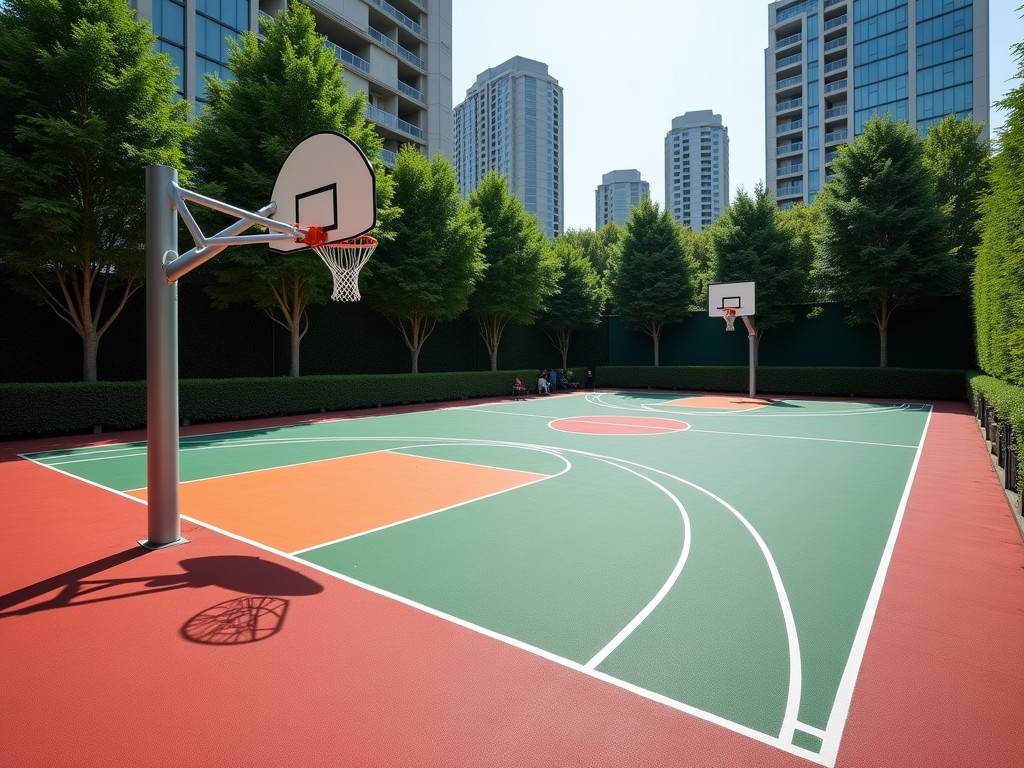
Backyard Basketball Court Interlocking Flooring System
Overview
The flooring system consists of modular polypropylene copolymer tiles that interlock via a tongue-and-groove mechanism, creating a seamless playing surface suitable for residential basketball courts.
Each tile measures 300 mm × 300 mm with a thickness of 15 mm, providing a balance between impact attenuation and lateral stability.
Material Composition
Tiles are produced from impact‑modified polypropylene copolymer (PP‑CO) blended with UV stabilizers and antioxidant packages.
The typical melt flow index (MFI) ranges from 6 to 9 g/10 min (230 °C/2.16 kg), ensuring adequate flow during injection molding while maintaining stiffness.
Additives include 0.5 wt % hindered amine light stabilizer (HALS) and 0.2 wt % phosphite‑based antioxidant, extending outdoor service life to more than 8 years under direct sunlight.
Performance Characteristics
| Property | Test Method | Typical Value |
|---|---|---|
| Shock absorption (ASTM F2772) | ASTM F2772 | ≥ 35 % |
| Vertical deformation | ASTM F2772 | ≤ 5 mm |
| Tensile strength | ISO 527‑2 | ≥ 25 MPa |
| Coefficient of friction (wet) | ASTM E303 | 0.55 – 0.65 |
| UV resistance (color change ΔE after 1500 h) | ISO 4892‑2 | ΔE ≤ 4 |
Values represent averages from production lots; individual tiles may vary within ±5 %.
Installation Method
Tiles are laid directly on a compacted gravel base or existing concrete slab; no adhesives are required.
Interlock is achieved by pressing the male edge of one tile into the female edge of the adjacent tile, using a rubber mallet to ensure full engagement.
A typical 5 m × 3 m court requires 500 tiles and can be installed by two workers in approximately 4 hours.
Applications and Benefits
The system provides a uniform surface with consistent ball bounce, reducing joint stress during repetitive jumping and lateral movements.
Because the tiles are permeable, water drains through the joints, preventing puddle formation and allowing use after light rain.
The modular design enables removal and re‑configuration, supporting seasonal storage or court resizing without permanent alteration to the substrate.
Quality Control Philosophy
Each production batch undergoes melt flow inspection, density measurement, and visual inspection for flash or warpage.
Finished tiles are sampled for impact resistance using a falling weight tester (ASTM D5420) with a 2 kg striker dropped from 1 m height; acceptance requires no cracking.
Dimensional tolerances are held to ±0.5 mm on length and width, and ±0.2 mm on thickness, ensuring tight interlock across the entire court.
Customization Options
- Color: standard safety orange, royal blue, forest green, or custom Pantone matched upon request.
- Surface texture: smooth finish for multi‑use or textured anti‑slip pattern for high‑traffic zones.
- Edge treatment: beveled perimeter pieces to reduce tripping hazards at court boundaries.
- Thickness variants: 12 mm for low‑impact recreation, 20 mm for competitive play.
Frequently Asked Questions
Can dimensions be customized?
Tile size is fixed at 300 mm × 300 mm to maintain interlock integrity; however, court layout can be scaled by adding or removing tiles, and perimeter fillers are available for non‑standard shapes.
What information is required before quotation?
Project dimensions (length × width), desired color/texture, substrate condition (soil, concrete, asphalt), and any required accessories such as edge ramps or drainage inserts.
How is quality inspected?
Incoming raw material is tested for MFI and tensile strength; in‑process checks monitor injection pressure and cooling time; final inspection includes dimensional check, impact test, and UV stability sampling.
What packaging methods are available?
Tiles are stacked in layers with corrugated separators, placed on pallets (1.0 m × 1.2 m) and secured with stretch film; each pallet holds approximately 200 tiles.
How are export shipments protected?
Pallets are fitted with corner boards and placed inside ISPM‑15 compliant wooden crates; moisture‑absorbent desiccant packets are included to limit humidity during transit.
What is the typical production lead time?
For standard colors, lead time is 2–3 weeks after receipt of deposit; custom colors or textures may extend to 4–5 weeks.
Contact for Technical Inquiry
To request a detailed quotation, submit your project specifications via the contact form.
Request Quote