Best Price Cost Of Outdoor Basketball Court Flooring Supplier
Best Price Cost Of Outdoor Basketball Court Flooring Supplier
Best Price Outdoor Basketball Court Flooring Supplier
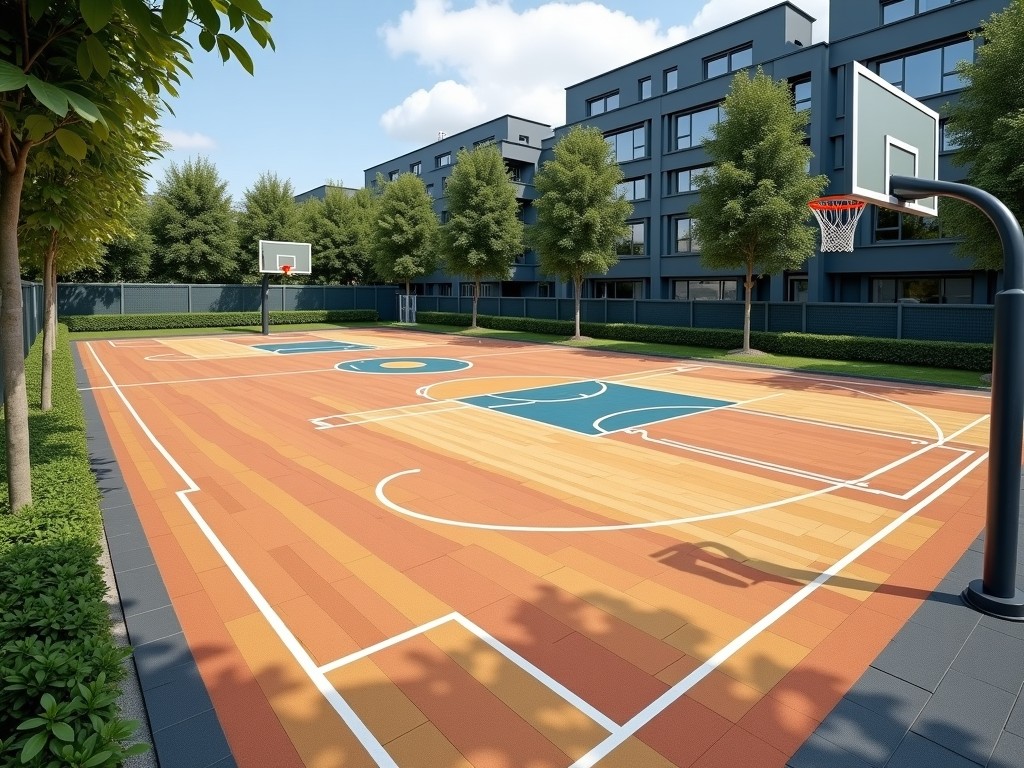
Outdoor basketball court flooring is engineered to withstand repeated impact, weather exposure, and frequent cleaning while providing consistent ball bounce and player traction. The system typically consists of interlocking tiles or poured-in-place layers that distribute loads across a stable sub‑base.
Material selection influences long‑term performance. Common bases include UV‑stabilized polypropylene for modular tiles, recycled rubber granules for shock‑absorbing underlayers, and polyvinyl chloride (PVC) blends for wear surfaces. Each formulation is chosen based on required thickness, expected load, and environmental conditions.
Typical Performance Characteristics
| Property | Value (Customizable) | Test Method / Reference |
|---|---|---|
| Thickness | Project‑specific (10 mm – 20 mm typical range) | Project specification |
| Shock absorption | Adjustable per formulation | ASTM F2772 |
| Vertical deformation | Tunable to meet play standards | ASTM F2772 |
| Coefficient of friction (wet) | Formulation dependent | ASTM F2508 |
| UV stability | Based on additive package | ASTM G154 |
Installation begins with a compacted gravel or concrete base that meets flatness tolerances of ±3 mm over a 2 m span. Interlocking tiles are placed without adhesives, allowing for thermal expansion and easy replacement of damaged units. For poured systems, a primer is applied, followed by mixing and troweling of the resin‑rubber compound to the specified thickness.
- Verify base flatness and moisture content before laying.
- Lay tiles with a staggered joint pattern to enhance load distribution.
- Cut edge pieces using a fine‑tooth saw to fit perimeter constraints.
- Perform a roll test to confirm uniform ball rebound across the surface.
Applications and Suitability
Outdoor courts experience temperature swings, UV radiation, and occasional standing water. Flooring that retains flexibility at low temperatures and resists embrittlement under prolonged sun exposure reduces cracking and delamination. The modular tile approach also permits rapid drainage through peripheral gaps, limiting water accumulation that could promote algae growth or slip hazards.
Facilities such as community parks, school campuses, and commercial recreation centers benefit from a surface that can be re‑configured for different sports or event layouts without permanent alteration. The ability to replace individual tiles minimizes downtime and life‑cycle cost compared with resurfacing monolithic slabs.
Quality Control Philosophy
Each production batch undergoes dimensional checks on tile thickness and interlock geometry using calibrated laser gauges. Impact resistance is validated by dropping a standardized weight from a defined height and measuring rebound height. UV exposure samples are subjected to accelerated weathering cycles, after which color change and tensile strength are measured to confirm stability.
Customization Options
Customers may specify tile color patterns to match team branding, incorporate logo inlays via inset pads, or select varying shore hardness values for the top layer to fine‑tune ball speed. Thickness can be increased in high‑traffic zones such as free‑throw lines while keeping perimeter areas lighter to reduce material cost.
Frequently Asked Questions
Can dimensions be customized?
Tile size and court layout are adjustable to fit existing site dimensions; custom cuts are performed at the factory to minimize on‑site waste.
What information is required before quotation?
Project planners should provide sub‑base type, expected load classification, desired color scheme, and any regulatory standards (e.g., FIBA, local accessibility codes) that apply.
How is quality inspected before shipment?
Final inspection includes visual inspection for surface defects, dimensional verification of a random sample, and functional testing of interlock engagement force to confirm ease of installation and long‑term security.
For detailed specifications, pricing, or to arrange a sample shipment, please contact our technical sales team.
Request Quote & Technical Data