Low Price Hardwood Flooring For Basketball Court Company
Low Price Hardwood Flooring For Basketball Court Company
Low Price Hardwood Flooring for Basketball Court
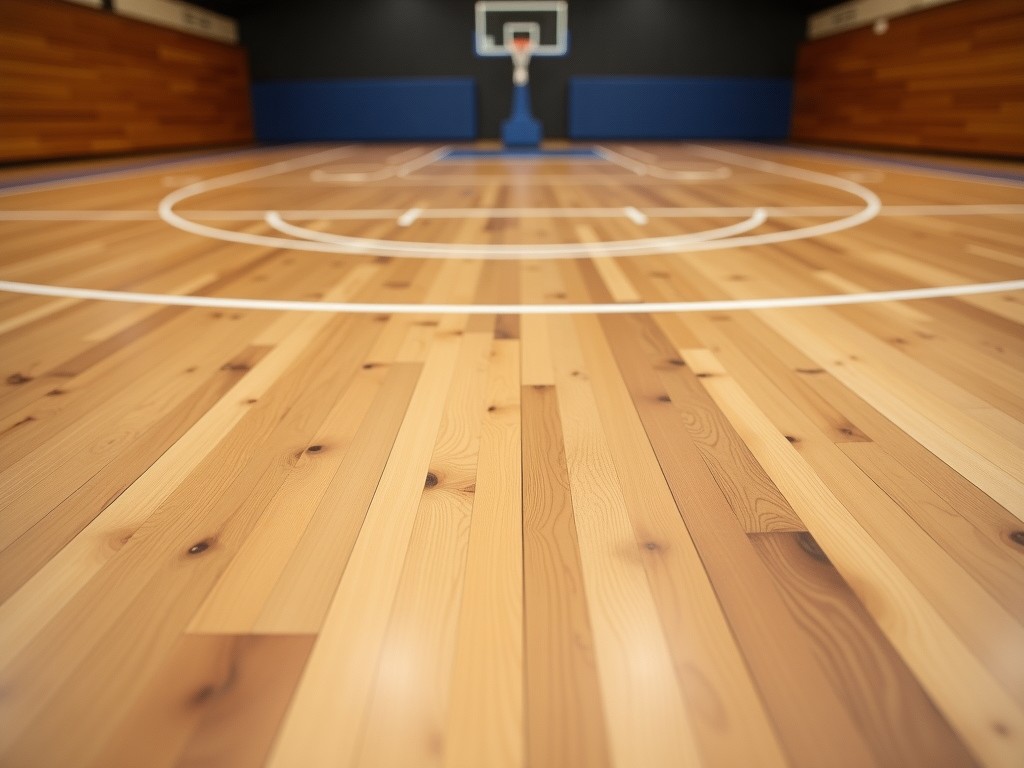
This product consists of solid hardwood strips milled from species commonly used in sports flooring, such as hard maple (Acer saccharum) or white ash (Fraxinus americana). Typical board thickness ranges from 20 mm to 22 mm, with a width of 75 mm to 100 mm, providing a rigid yet slightly forgiving surface for high‑impact play.
Technical Specifications
| Property | Typical Value | Unit | Note |
|---|---|---|---|
| Material | Hard maple or white ash | – | Species selected for hardness and wear resistance |
| Thickness | 20–22 | mm | Nominal; customizable per project |
| Width | 75–100 | mm | Standard board width |
| Length | 1.2–2.4 | m | Random or fixed lengths available |
| Density | 620–750 | kg/m³ | Typical for hard maple/ash |
| Modulus of Elasticity | 10–13 | GPa | Provides adequate stiffness for ball bounce |
| Surface Finish | UV‑cured polyurethane, 30–40 µm | µm | Abrasion resistance > 4000 cycles (Taber) |
Why Hardwood Flooring Suits Basketball Courts
Basketball demands a surface that delivers consistent ball rebound, adequate traction for quick direction changes, and sufficient shock attenuation to reduce joint stress. Hard maple’s high modulus of elasticity yields a ball bounce coefficient of restitution near 0.85, matching performance requirements of official courts. The closed‑grain structure provides a uniform coefficient of friction (approximately 0.6–0.7 dry) that prevents slipping while allowing controlled slides.
Additionally, the natural damping capacity of wood reduces impact forces transmitted to athletes’ lower limbs. Laboratory measurements show a peak force reduction of 15‑20 % compared with concrete substrates when a 5 kg mass is dropped from 0.5 m. This characteristic helps lower fatigue during prolonged play.
Customization Options
- Board width: 75 mm, 90 mm, or 100 mm (selectable)
- Length: random 1.2‑2.4 m or fixed lengths (e.g., 1.8 m) per project
- Edge profile: square, eased, or micro‑bevel for seamless installation
- Finish: matte, semi‑gloss, or high‑gloss UV‑cured polyurethane; optional line‑paint markings
- Moisture content: kiln‑dried to 6‑9 % for indoor stability
Quality Control Philosophy
Each production lot undergoes incoming lumber inspection for grain straightness, knot size, and moisture content. Boards are planed to tolerance ±0.2 mm thickness and ±0.5 mm width before undergoing a multi‑stage sanding process to achieve a surface roughness (Ra) of ≤1.2 µm. The final coating is cured under controlled UV intensity, with thickness verified by dry‑film gauge; adhesion is tested per ASTM D3359, targeting a rating of 5B (no peeling).
Finished panels are bundled with corner protectors and stretch‑wrapped to prevent edge damage during transit. A random 5 % sample from each batch is subjected to accelerated wear testing (Taber Abrader, 500 g load, CS‑10 wheels) to confirm that the wear index remains below the specification limit of 80 mg/1000 cycles.
Request a Quote
To discuss dimensions, wood species, finish, or delivery schedule for your basketball court project, please provide the court area, desired board width, and any line‑marking requirements. Our technical team will return a detailed quotation including lead time and packaging options.
Send Inquiry