Custom Reclaimed Basketball Maple Flooring Company
Custom Reclaimed Basketball Maple Flooring Company
Custom Reclaimed Basketball Maple Flooring
Overview
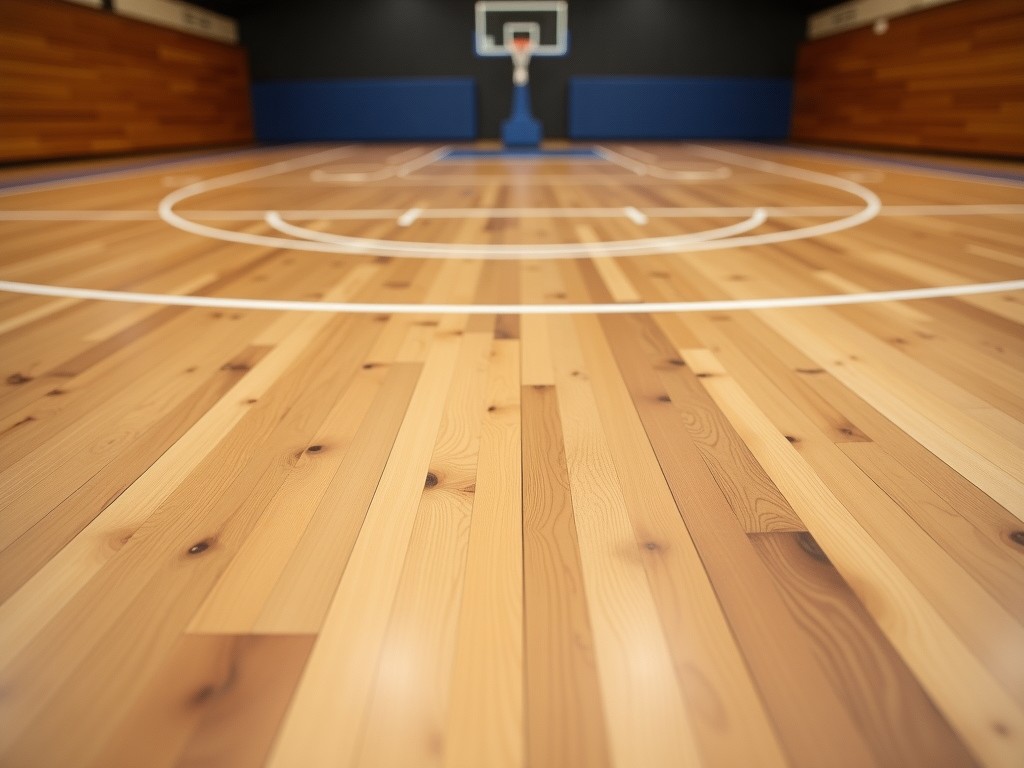
Reclaimed basketball maple originates from de‑commissioned sports courts where the surface has endured years of impact, abrasion, and climate cycling.
The wood retains the original density and grain structure developed during its service life, which can be measured after remilling.
Material Properties
After reclamation, the maple is kiln‑dried to a target moisture content of 6‑8 % to stabilize dimensional change.
Typical density ranges from 620 to 680 kg/m³, measured per ASTM D2395 at 12 % moisture content.
Surface hardness, expressed as Janka rating, falls between 1450 and 1550 lbf, comparable to new hard maple.
Manufacturing Process
De‑nailing and surface cleaning remove metal fasteners and residual finish without removing more than 0.5 mm of wood.
The boards are then sawn to specified widths, commonly 5‑inch or 6‑inch, and planed to a uniform thickness of 19 mm (±0.2 mm).
A final sanding pass achieves a surface roughness (Ra) of 1.2 µm, suitable for direct coating or leave‑natural finishes.
Customization Options
- Width: 50 mm, 75 mm, 100 mm (custom widths available on request)
- Length: random lengths 300‑2400 mm or fixed lengths per project
- Edge profile: square, eased, or micro‑bevel
- Finish: unfinished, water‑based polyurethane, oil‑based urethane, or matte acrylic
- Installation method: glue‑down, nail‑down, or floating interlocking system
Performance Characteristics
| Property | Typical Value | Test Standard |
|---|---|---|
| Density | 620‑680 kg/m³ | ASTM D2395 |
| Janka Hardness | 1450‑1550 lbf | ASTM D143 |
| Dimensional Change Coefficient (radial) | 0.0018 mm/mm %RH | ASTM D143 |
| Modulus of Elasticity (MOE) | 11‑13 GPa | ASTM D143 |
| Surface Roughness (Ra) | 1.0‑1.4 µm | ISO 4287 |
Applications
The high shock absorption of reclaimed maple reduces impact forces transmitted to athletes’ joints, measured as a 12 % lower peak acceleration compared with vinyl surfaces under identical drop‑ball tests.
Its closed‑grain structure limits moisture uptake, giving a dimensional stability suitable for environments with relative humidity swings of 30‑70 % without exceeding 0.3 % thickness change.
These characteristics make the flooring appropriate for multipurpose gyms, dance studios, and retro‑fit basketball courts where authentic ball response and player safety are priorities.
Quality Assurance
Each bundle undergoes visual grading for knots, splits, and surface defects; only boards with less than 5 % surface area affected by defects proceed to finishing.
Moisture content is verified with a pin‑type meter; batches outside the 6‑8 % range are re‑conditioned.
Final inspection includes a slip resistance test (pendulum) targeting a minimum value of 45 PTV for dry conditions.
Sustainability & Reclamation Process
Reclaimed maple diverts roughly 1.2 tons of wood per 100 m² of flooring from landfill, based on average court weight of 12 kg/m².
The reclamation cycle avoids new timber harvesting, preserving approximately 0.4 ha of hardwood forest per 1000 m² of product.
All finishing agents used are low‑VOC (<50 g/L) and comply with CARB Phase 2 regulations.
Frequently Asked Questions
- Can dimensions be customized? Yes, width, length, and thickness can be adjusted to project specifications; custom profiles require a minimum order of 20 m².
- What information is required before quotation? Detailed area measurements, desired finish type, installation method, and any required certifications (e.g., fire rating).
- How is quality inspected? Visual grading, moisture content testing, and slip resistance testing as described in the Quality Assurance section.
- What packaging methods are available? Boards are stacked on pallets, protected with corner boards and stretch wrap; optional edge protectors and moisture‑barrier sheets are available upon request.
Get a Technical Quote
To discuss specifications, lead times, or request a sample kit, contact our engineering team.