B2B Hardwood Basketball Court Installation Factory
B2B Hardwood Basketball Court Installation Factory
B2B Hardwood Basketball Court Installation Factory
Overview
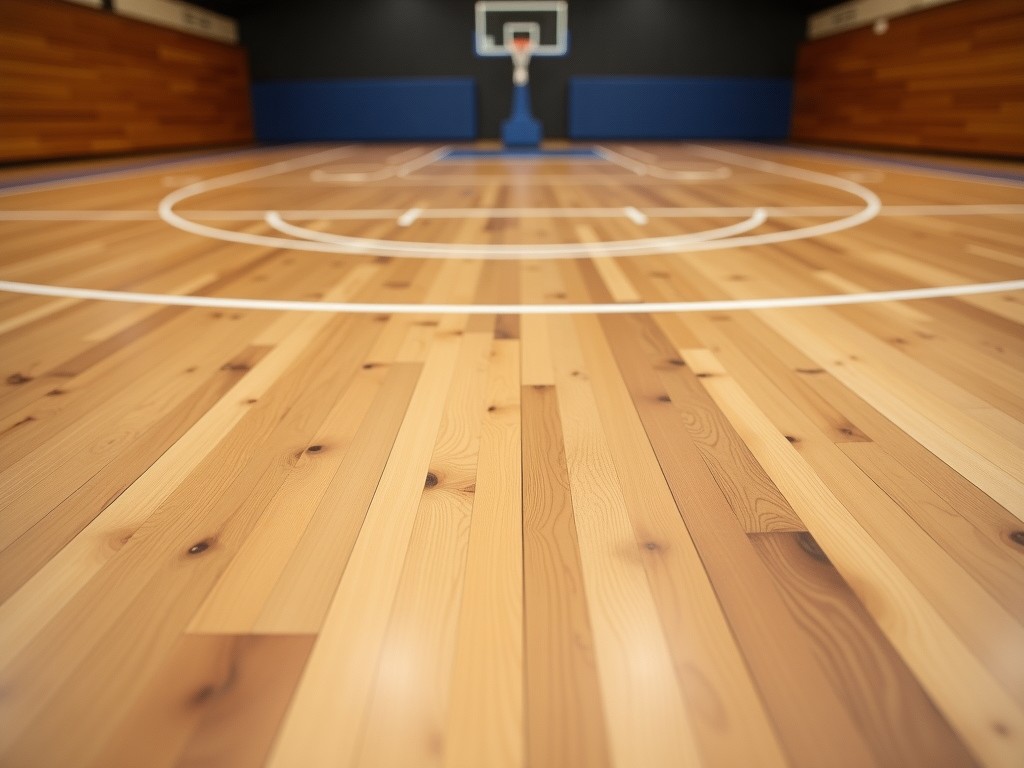
Our facility produces solid hardwood courts designed for permanent indoor basketball facilities. Each panel is milled from select maple or birch lumber, kiln‑dried to 6‑8% moisture content, and machined to a nominal thickness of 22 mm with a tolerance of ±0.5 mm. The surface is sanded to a finish roughness of Ra 0.8 µm before applying a two‑coat polyurethane system that yields a Shore D hardness of 80 and a static coefficient of friction between 0.55 and 0.65, meeting FIBA‑specified performance for ball bounce and player traction.
Key Technical Specifications
| Parameter | Typical Value | Notes |
|---|---|---|
| Material | Select hard maple (Acer saccharum) or birch (Betula spp.) | Grade #1, kiln‑dried |
| Nominal thickness | 22 mm | ±0.5 mm tolerance |
| Width per plank | 60 mm (standard) – customizable 45‑80 mm | Tongue‑and‑groove profile |
| Length per plank | Up to 2.4 m (standard) – custom lengths available | End‑matched for seamless joints |
| Surface finish | Two‑coat water‑based polyurethane | Shore D ≈ 80, Ra 0.8 µm |
| Static coefficient of friction | 0.55‑0.65 (ASTM D2047) | Meets FIBA requirement |
| Ball rebound resilience | ≥ 90 % (ASTM F2117) | Measured at 20 °C |
| Weight per square meter | ≈ 38 kg/m² | Includes underlayment |
Material Selection & Preparation
Logs are sawn to quarter‑sawn orientation to minimize tangential movement and enhance dimensional stability. After initial sawing, boards undergo a two‑stage kiln schedule: first to 12% MC, then conditioned to 6‑8% MC over 48 hours. This reduces the risk of cupping or crowning after installation. Each board is inspected for knots, splits, and grain deviation; only boards with less than 5 % knot area and slope of grain < 1:15 proceed to machining.
The tongue‑and‑groove profile is cut with a 0.8 mm clearance to allow for seasonal expansion while maintaining a tight joint. Edge sealing with a moisture‑resistant primer is applied before the finish coats to limit moisture ingress at the joints.
Installation Process
Courts are installed over a vapor‑barrier and a 12 mm thick high‑density foam underlayment that provides shock absorption (force reduction ≥ 55 %). The hardwood panels are laid perpendicular to the primary playing direction, with a 2 mm expansion gap at the perimeter covered by flexible baseboard. Adhesive‑free interlocking relies on the tongue‑and‑groove mechanism; mechanical fasteners (stainless‑steel cleats) are used only at the perimeter for additional restraint.
After laying, the surface is sanded lightly (120‑grit) to remove any micro‑high spots, then cleaned before applying the polyurethane finish. The finish is cured under controlled temperature (20‑22 °C) and humidity (45‑55 %) for 24 hours between coats, achieving full hardness after 7 days.
Quality Control Philosophy
Every production lot undergoes three checkpoints: incoming lumber grade verification, in‑process dimensional monitoring (laser gauging every 5 m), and final surface performance testing. The final test includes a ball rebound test (three‑ball average), a slip resistance measurement (British Pendulum), and a gloss measurement (60° gloss unit < 30). Only lots that meet all three criteria are released for shipment.
Documentation includes a material certificate, kiln‑dry record, machining tolerance report, and finish cure log, all provided with each shipment.
Applications
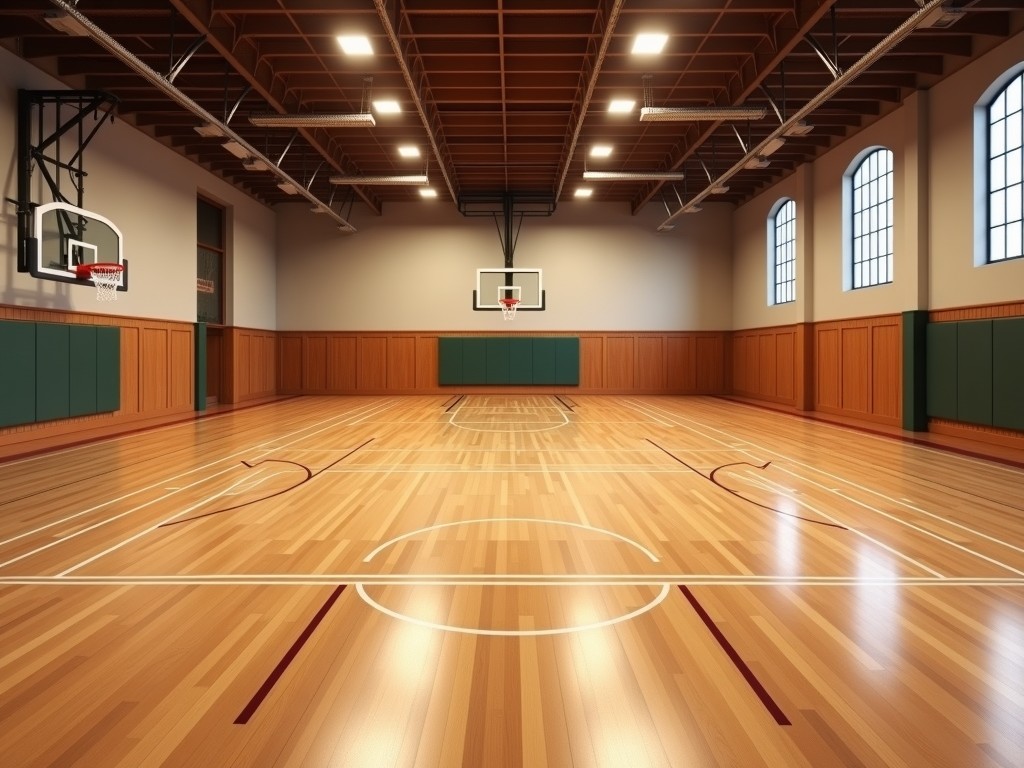
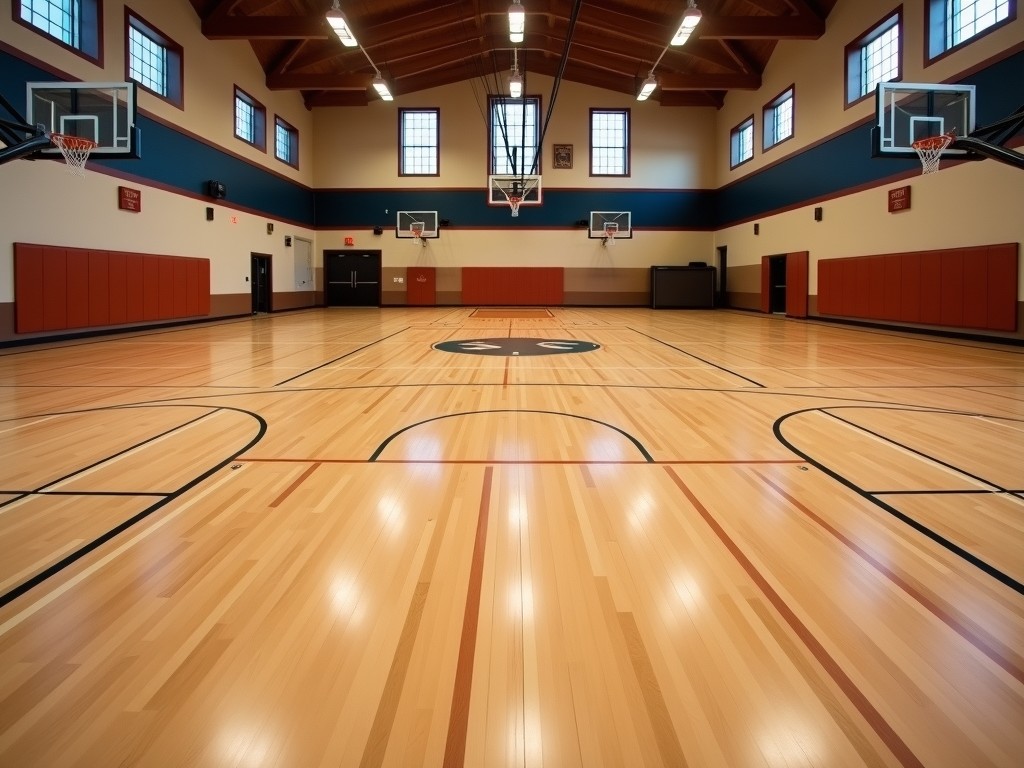
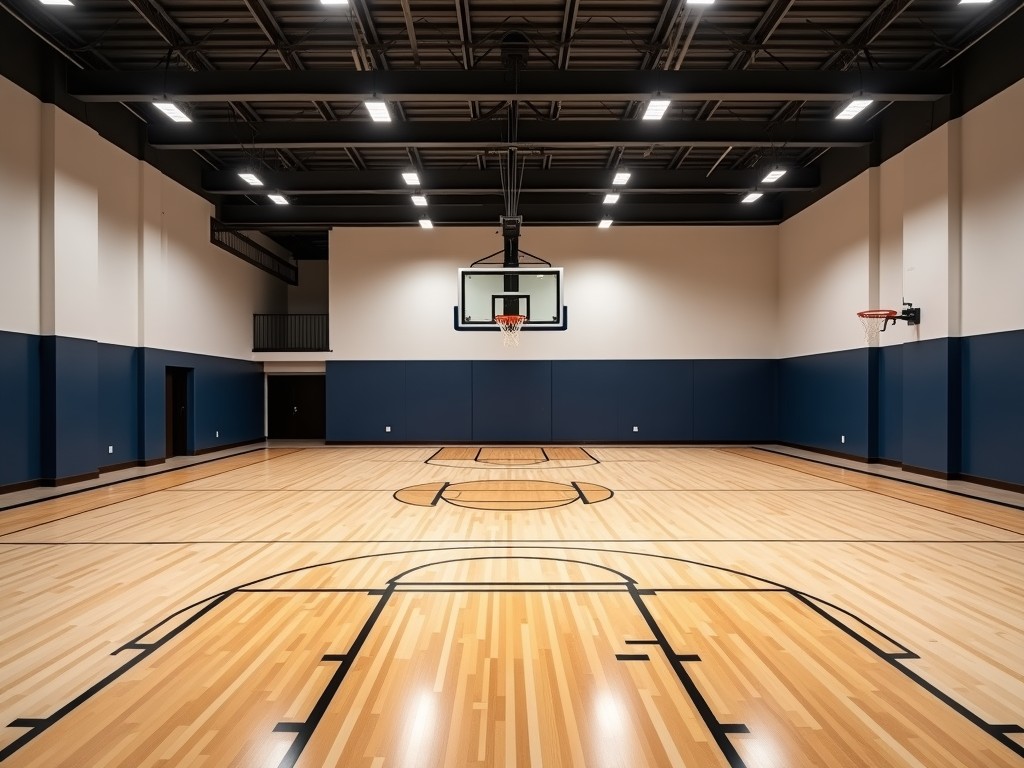
The hardwood court system is suited for permanent installations in educational institutions, professional training facilities, and multi‑purpose sports complexes where a consistent playing surface is required for basketball, volleyball, and indoor athletics. The high dimensional stability reduces maintenance cycles, while the specified friction and rebound values support compliance with league standards.
Customization Options
- Plank width: 45 mm, 60 mm, 80 mm (tongue‑and‑groove)
- Plank length: up to 3.0 m (end‑matched)
- Finish: matte (gloss < 20) or semi‑gloss (gloss 30‑40)
- Color tint: natural, light amber, or custom stain (UV‑stable)
- Underlayment thickness: 10 mm, 12 mm, 15 mm foam or rubber
FAQ
Can dimensions be customized?
Yes. Plank width, length, and thickness can be adjusted to suit project‑specific layout constraints. Custom lengths require end‑matching to maintain joint integrity.
What information is required before quotation?
Project area (square meters), desired plank dimensions, finish type, underlayment preference, and any required line‑marking specifications.
How is quality inspected?
Incoming lumber is graded, dimensions are checked with laser gauges every 5 m, and finished panels undergo ball rebound, slip resistance, and gloss tests before release.
What packaging methods are available?
Panels are stacked in pallets with edge protectors, wrapped in polyethylene film, and secured with steel straps. For export, pallets are fumigated and placed in ISO containers with moisture‑absorbing desiccants.
What is the typical production lead time?
Lead time ranges from 4 to 6 weeks after receipt of approved drawings and deposit, depending on order size and customization complexity.
Contact for Inquiry
To request a detailed quotation, technical datasheet, or sample panel, please reach out to our technical sales team.
Request Quote