Oem Interlocking Volleyball Court Sport Tiles Company
Oem Interlocking Volleyball Court Sport Tiles Company
OEM Interlocking Volleyball Court Sport Tiles
Product Overview
Modular interlocking tiles create a seamless playing surface that can be installed and removed without adhesives or specialized tools. Each unit measures 300 mm × 300 mm with a thickness of 15 mm, providing a stable platform that accommodates slight sub‑grade irregularities while maintaining uniform ball rebound characteristics.
The system supports both permanent installations and temporary event flooring, allowing facility managers to re‑configure courts for multi‑sport use or seasonal storage.
Material Composition
Tiles are produced from copolymer polypropylene (PP) blended with impact‑modifying ethylene‑propylene‑diene monomer (EPDM) granules. The PP matrix provides chemical resistance and UV stability, while the EPDM additive enhances shock absorption and slip resistance.
A UV stabilizer package (hindered amine light stabilizers at 0.2 wt %) extends outdoor service life to ≥5 years under direct sunlight, and antioxidant additives prevent oxidative degradation during prolonged indoor use.
Interlocking Mechanism
Each tile features a male‑female tongue‑and‑groove profile on all four sides. The male tab incorporates a 2 mm × 2 mm undercut that engages a corresponding female socket, providing shear resistance of approximately 1.8 kN per joint under static load.
A secondary locking rib runs parallel to the primary joint, adding lateral stiffness and preventing disengagement under dynamic loads typical of volleyball play (peak impact forces up to 3 kN).
Performance Characteristics
| Property | Typical Value | Test Standard |
|---|---|---|
| Compressive Strength | 2.5 MPa | ASTM D695 |
| Flexural Modulus | 1.1 GPa | ASTM D790 |
| Coefficient of Friction (wet) | 0.62 | ASTM F2913 |
| Vertical Deformation @ 500 N | 1.8 mm | EN 14904 |
| Thermal Expansion Coefficient | 1.1×10⁻⁴ / °C | ASTM D696 |
Customization Options
- Tile dimensions: 300 mm × 300 mm (standard) or 500 mm × 500 mm (large format) – thickness adjustable from 12 mm to 20 mm.
- Surface textures: smooth, fine‑grain, or anti‑slip ribbed patterns (Ra values 0.4–1.2 µm).
- Color palette: standard RAL colors, custom Pantone matches, or two‑tone zoning for court markings.
- Logo or graphics embedding via in‑mold labeling or post‑cure UV printing (resolution ≥300 dpi).
- Edge treatments: beveled, chamfered, or square‑edge profiles to match surrounding flooring transitions.
Primary Applications
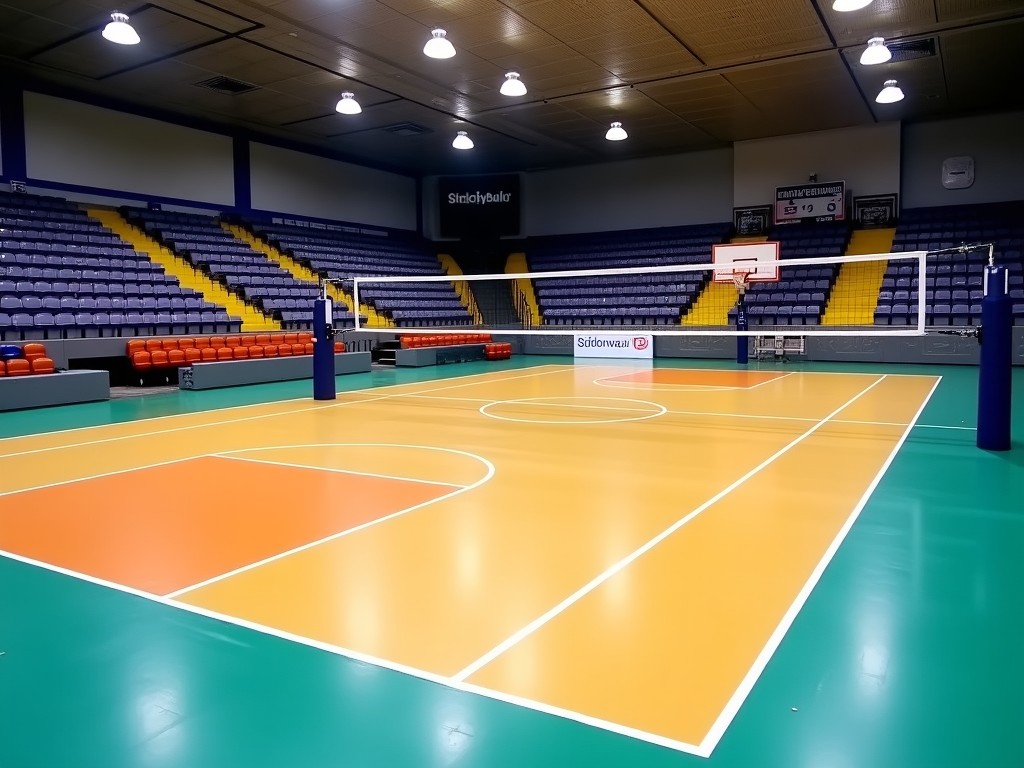
Volleyball courts demand a surface that provides consistent ball bounce, adequate traction for lateral movements, and impact attenuation to reduce joint stress. The interlocking tile system delivers a vertical deformation of ~1.8 mm under a 500 N load, which falls within the range specified for sports flooring (EN 14904) and offers a rebound elasticity comparable to traditional hardwood courts.
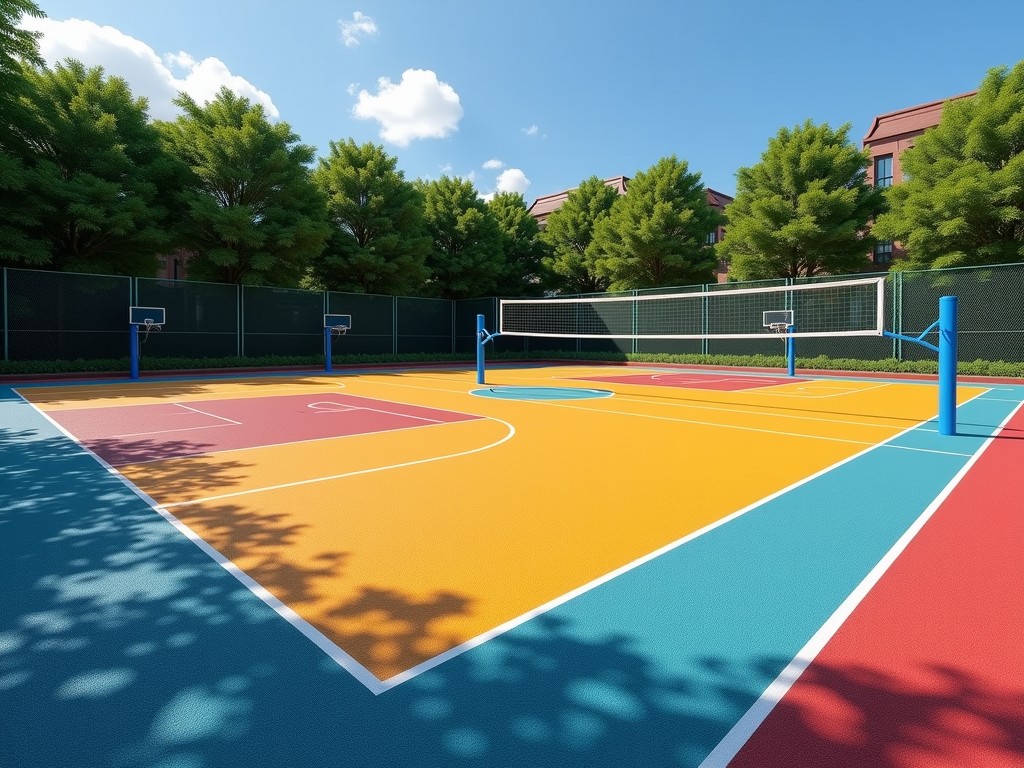
The permeable design allows rapid drainage of water or sweat, preventing puddle formation and maintaining a dry playing area. UV‑stabilized polypropylene ensures colorfastness and mechanical integrity when installed outdoors, making the tiles suitable for beach volleyball, schoolyards, and temporary event venues.
Quality Control & Testing
Production follows ISO 9001‑aligned procedures with in‑line dimensional checks (±0.2 mm tolerance on length/width, ±0.1 mm on thickness). Each batch undergoes random sampling for impact resistance (Charpy notched test ≥45 J/m) and abrasion loss (Taber ≤80 mg/1000 cycles).
Finished tiles are inspected for surface defects using 10× magnification lighting; any visible flash, sink marks, or discoloration results in rejection. Traceability is maintained via laser‑etched batch codes on the tile underside.
Installation Considerations
Tiles are laid directly over a prepared base—clean, level concrete, asphalt, or compacted crushed stone with a maximum deviation of 3 mm over a 2 m span. No adhesive is required; the interlocking joints provide sufficient shear resistance for loads up to 5 kN/m².
A perimeter restraint system (aluminum or PVC edge strip) is recommended to prevent lateral movement under cyclic loading. For indoor installations, a vapor barrier film (0.15 mm PE) may be placed beneath the tiles to mitigate moisture transmission.
Packaging & Logistics
Tiles are stacked in layers of 20 units, separated by corrugated cardboard sheets, and unitized on 1.2 m × 1.0 m pallets. Each pallet is secured with stretch film and corner boards, providing a typical net weight of ~250 kg (depending on thickness).
Pallets are designed for forklift handling from all four sides and conform to ISPM‑15 standards for export shipments. Custom packaging options include double‑wall cartons for air freight or reusable plastic totes for closed‑loop logistics.
Frequently Asked Questions
Can tile dimensions be customized for specific court layouts?
Yes. Both length and width can be adjusted in 50 mm increments, and thickness can be tailored between 12 mm and 20 mm to meet load or cushioning requirements.
What information is needed to prepare a quotation?
Required details include court area (square meters), desired tile size/thickness, surface texture, color or logo specifications, and any edge‑finish preferences.
Which materials are available for the tile body?
Standard offering is polypropylene/EPDM copolymer; alternative materials such as recycled PP or thermoplastic elastomer blends are available upon request.
How is product quality verified before shipment?
Each lot undergoes dimensional inspection, impact testing, and abrasion testing per the standards listed in the performance table. A batch certificate of conformance is provided with every shipment.
What packaging methods protect tiles during transit?
Tiles are palletized with interleaving corrugated sheets, stretch‑wrapped, and corner‑reinforced. For high‑humidity climates, desiccant packs and internal PE liners can be added.
What is the typical production lead time?
Lead time ranges from 3 to 4 weeks for standard configurations; custom colors or logos may extend the schedule to 5–6 weeks.
How are samples arranged for evaluation?
Sample sets (typically 9 tiles) can be shipped via express courier at the recipient’s expense, or arranged through a local distributor for regional evaluation.
Contact for OEM Inquiry
To discuss project‑specific requirements, request technical datasheets, or obtain a formal quotation, please reach out via the contact form.
Submit Inquiry