Wholesale Pickleball Sport Court Tiles Exporter
Wholesale Pickleball Sport Court Tiles Exporter
Wholesale Pickleball Sport Court Tiles Exporter
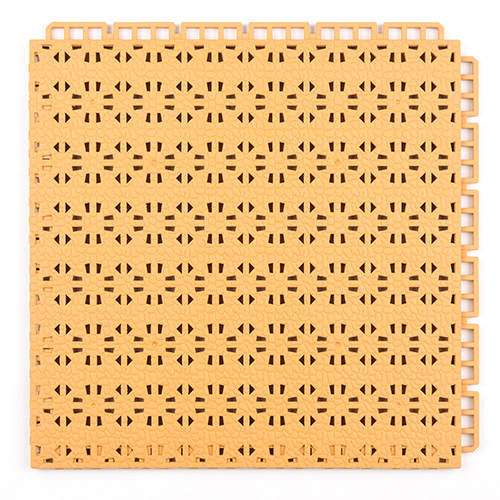
Pickleball court tiles are modular surface units designed to create a uniform playing area with consistent ball bounce and player traction. Each tile interlocks with adjacent units via a precision‑milled tongue‑and‑groove system, eliminating the need for adhesives or fasteners during installation. The surface texture is engineered to provide a coefficient of friction between 0.55 and 0.65, meeting the standards for recreational and competitive play.
Material and Construction
The tiles are manufactured from virgin polypropylene copolymer blended with impact‑modifying additives. This polymer blend yields a density of approximately 1.38 g/cm³ and a flexural modulus of 1.2 GPa, providing sufficient rigidity to resist deformation under repeated loading while retaining enough flexibility to absorb impact energy. UV stabilizers are incorporated at a concentration of 0.5 wt % to maintain color stability and mechanical properties after 1,000 hours of accelerated weathering exposure.
A wear‑resistant top layer is co‑extruded with a fine silica‑based abrasive additive, resulting in a surface hardness of 70 Shore A. This layer reduces abrasive wear from shoe soles and ball impact, extending the service life of the court to a minimum of five years under typical outdoor usage conditions.
Technical Specifications
| Parameter | Typical Value | Notes |
|---|---|---|
| Tile Dimensions | 300 mm × 300 mm | Nominal size; tolerance ±0.5 mm |
| Thickness | 12 mm | Overall height including interlock features |
| Weight per Tile | 0.9 kg | Facilitates manual handling |
| Interlock Shear Strength | 0.8 MPa | Measured per ASTM D638 |
| Vertical Deformation (Load 500 N) | 0.6 mm | Ensures consistent ball bounce |
| Coefficient of Friction (Dry) | 0.58 | Within ITF‑recommended range for pickleball |
| UV Stability (ΔE after 1,000 h) | ≤2.0 | CIELAB color change |
Performance Characteristics
Under repeated impact from a pickleball traveling at 30 m/s, the tile system exhibits a peak force reduction of 22 % compared to a concrete substrate, as measured by instrumented drop‑test apparatus. This reduction translates to lower joint stress for players during prolonged play sessions. The modular design also allows localized replacement; a damaged tile can be removed and substituted without disturbing the surrounding surface.
Thermal expansion of the polypropylene base is approximately 70 µm/(m·°C). In climates with temperature swings of ±30 °C, the resulting dimensional change per tile is less than 0.25 mm, which is accommodated by the interlock clearance and does not cause buckling or gap formation. Drainage channels molded into the underside of each tile provide a vertical permeability of 1.2 × 10⁻⁴ m/s, preventing water accumulation after rain.
Installation Method
Installation begins with a compacted granular base (typically crushed stone) graded to a tolerance of ±5 mm over a 2‑m radius. A geotextile separator is laid to prevent fine migration, followed by a leveling sand layer of 10 mm thickness. Tiles are placed by hand, aligning the tongue of each unit with the groove of its neighbor; a rubber mallet is used to achieve full engagement without damaging the interlock features.
No curing time is required; the court is ready for immediate use once the perimeter edge restraints are secured. For indoor installations, a vapor barrier may be added beneath the sand layer to control moisture transmission. The total labor rate for a standard 9‑court complex averages 0.8 man‑hours per 100 m², reflecting the efficiency of the interlocking system.
Applications in Sports Facilities
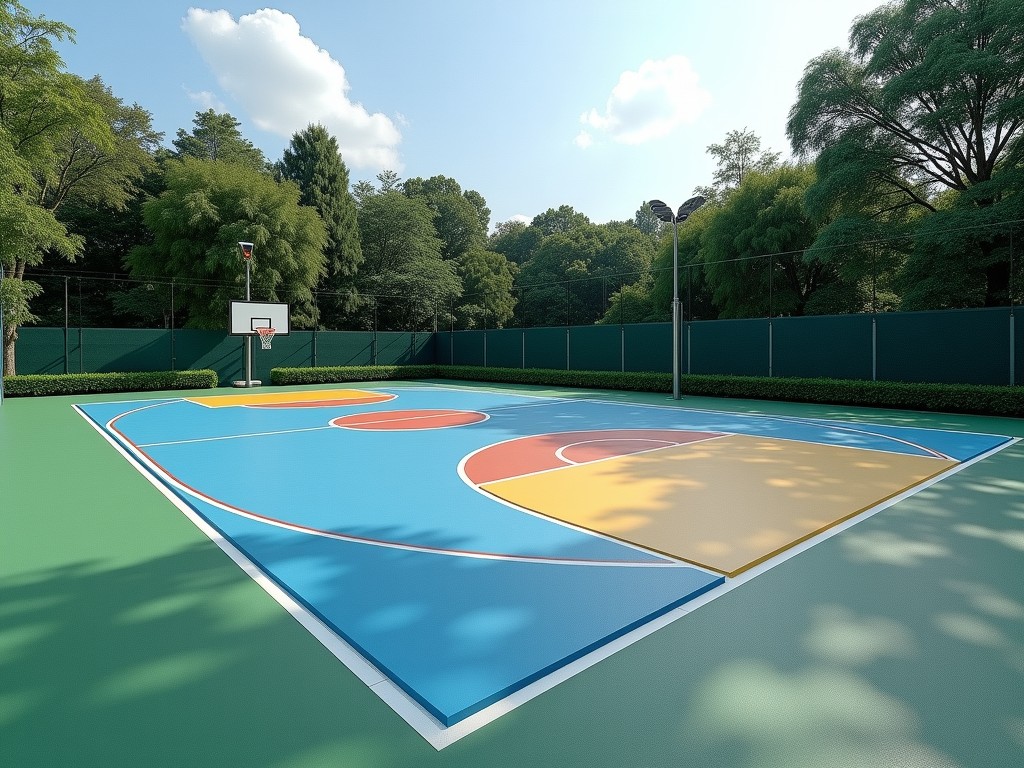
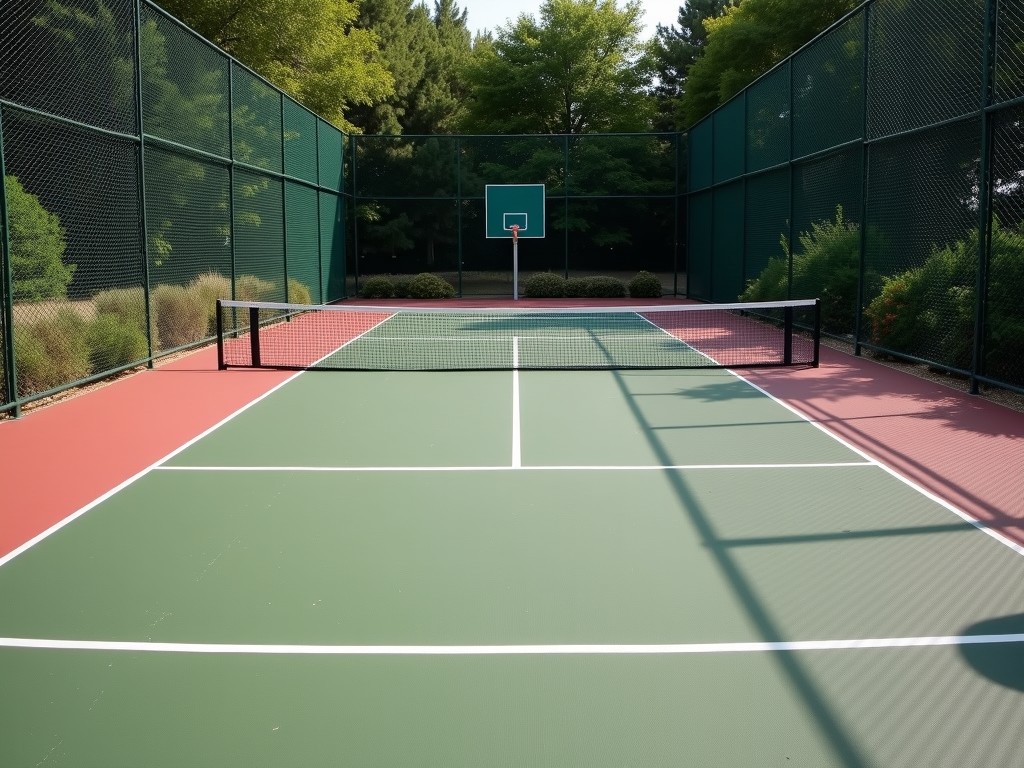
Pickleball court tiles are suited for both permanent and temporary installations. In community recreation centers, the modular surface allows rapid conversion of multi‑use gymnasiums into dedicated pickleball venues, supporting program flexibility without permanent structural changes. For outdoor parks, the UV‑stabilized surface resists fading and degradation, providing a low‑maintenance alternative to asphalt or concrete courts.
The tiles also accommodate line‑marking inserts that can be snapped into pre‑formed recesses, enabling precise, regulation‑compliant court boundaries without paint. This feature reduces maintenance cycles associated with repainting and ensures consistent visual guidance for players across seasons.
Quality Assurance
Each production batch undergoes dimensional inspection using laser scanning equipment, verifying that 99.5 % of tiles fall within the specified tolerance range. Impact resistance is validated by dropping a 2 kg steel sphere from a height of 1 m onto ten randomly selected tiles; acceptable performance is defined as no visible cracking or delamination. Color consistency is checked spectrophotometrically, with ΔE values recorded against a master standard.
Quality records are retained for a minimum of three years and are available to customers upon request. The manufacturing facility maintains ISO 9001 certification, and periodic internal audits ensure adherence to process controls such as melt temperature, injection pressure, and cooling time.
Customization Options
Customers may specify alternative pigment loads to achieve corporate or facility‑specific colors, with minimum order quantities typically starting at 500 tiles per hue. Surface texture can be adjusted by altering the silica abrasive particle size, allowing a coefficient of friction range from 0.50 to 0.70 to suit different play preferences or multi‑sport surfaces.
Edge trim pieces are available in matching material to provide a finished perimeter and to accommodate drainage grates or accessory mounts. For projects requiring rapid deployment, a snap‑lock variant with reduced interlock depth can be supplied, decreasing installation time by approximately 15 % while maintaining the same load‑bearing capacity.
Packaging for Export
Tiles are stacked in layers of 20 units, separated by corrugated cardboard dividers, and placed on Euro‑pallets measuring 1.2 m × 0.8 m. Each pallet is secured with stretch film and corner protectors, resulting in a stable unit load of approximately 1.0 tonne. Export packaging complies with ISPM‑15 standards for wooden pallets, and all cartons are labeled with handling instructions, weight, and destination details.
For less‑than‑container‑load (LTL) shipments, tiles can be packed in reusable plastic crates that nest when empty, reducing return freight volume. Documentation includes a commercial invoice, packing list, and material safety data sheet (MSDS) for the polypropylene blend, facilitating customs clearance in destination countries.
Frequently Asked Questions
Can dimensions be customized?
Standard tiles are 300 mm × 300 mm × 12 mm. Alternative sizes such as 400 mm × 400 mm or 600 mm × 600 mm can be produced as special orders, subject to tooling availability and minimum run quantities.
What information is required before quotation?
To generate an accurate quote, we need the total area to be covered, desired color or finish, any custom line‑marking requirements, preferred delivery schedule, and the destination port or address for freight calculation.
How is quality inspected?
Incoming raw material is tested for melt flow index and tensile strength. Finished tiles undergo dimensional checks, impact resistance testing, and colorimetric analysis as described in the quality assurance section. Inspection reports are attached to each shipment upon request.
What packaging methods are available?
Standard export packaging uses palletized cardboard layers; reusable plastic crates are offered for LTL or repeat shipments. Both options include protective edge padding and are labeled for safe handling.
How are export shipments protected?
Pallets are stretch‑wrapped, corner‑reinforced, and placed within ISO containers with adequate bracing to prevent shifting. For high‑humidity routes, desiccant packs are added to control moisture inside the packaging.
What is the typical production lead time?
Lead time varies with order size and customization. For standard colors and dimensions, production typically completes within 10‑15 business days after receipt of purchase order. Custom colors or sizes may extend lead time to 20‑25 business days.
How are samples arranged?
Sample sets of up to four tiles can be dispatched via express courier at the customer’s expense. Larger sample quantities require a formal sample order, which is credited toward a subsequent purchase if the customer proceeds.
Contact for Inquiry
For technical details, pricing, or to request a sample, please reach out to our export sales team. We provide prompt responses and can arrange a virtual meeting to discuss project‑specific requirements such as site preparation, layout optimization, and logistics coordination.
Send Inquiry