Custom Multi Sport Interlocking Floor Tiles Manufacturer
Custom Multi Sport Interlocking Floor Tiles Manufacturer
Custom Multi-Sport Interlocking Floor Tiles Manufacturer
Interlocking floor tiles for multi‑sport venues are engineered to provide a modular surface that can be assembled without adhesives, withstand repeated impact loads, and deliver consistent ball‑rebound and slip‑resistance characteristics across basketball, volleyball, futsal, and training activities.
Material Composition and Performance Characteristics
The tiles are produced from a virgin polypropylene‑ethylene copolymer blend modified with UV stabilizers and anti‑static additives. Typical thickness options range from 8 mm to 20 mm, Shore A hardness measures 88 ± 2, and tensile strength exceeds 15 MPa. Impact attenuation (measured per ASTM F355) yields a G‑max value below 120 g for the 12 mm variant, suitable for athlete safety standards.
Interlocking Mechanism Design
Each tile features a reinforced tongue‑and‑groove profile on all four sides, with a locking rib that engages under a shear load of at least 2.5 kN per joint. The design accommodates thermal expansion of up to 0.02 mm/m·°C while maintaining vertical load transfer exceeding 30 kN per tile without joint separation.
Customization Options
- Thickness: 8 mm, 10 mm, 12 mm, 15 mm, 20 mm (customizable per project)
- Surface texture: smooth, fine‑grain, or anti‑slip ribbed (RA values 0.4–0.8 µm)
- Color: standard RAL palette or custom pigment matching (ΔE < 2)
- Logo or line‑mark embedding via recessed pockets or surface engraving
- Edge finishing: straight, beveled, or ramped for transition zones
Application Suitability
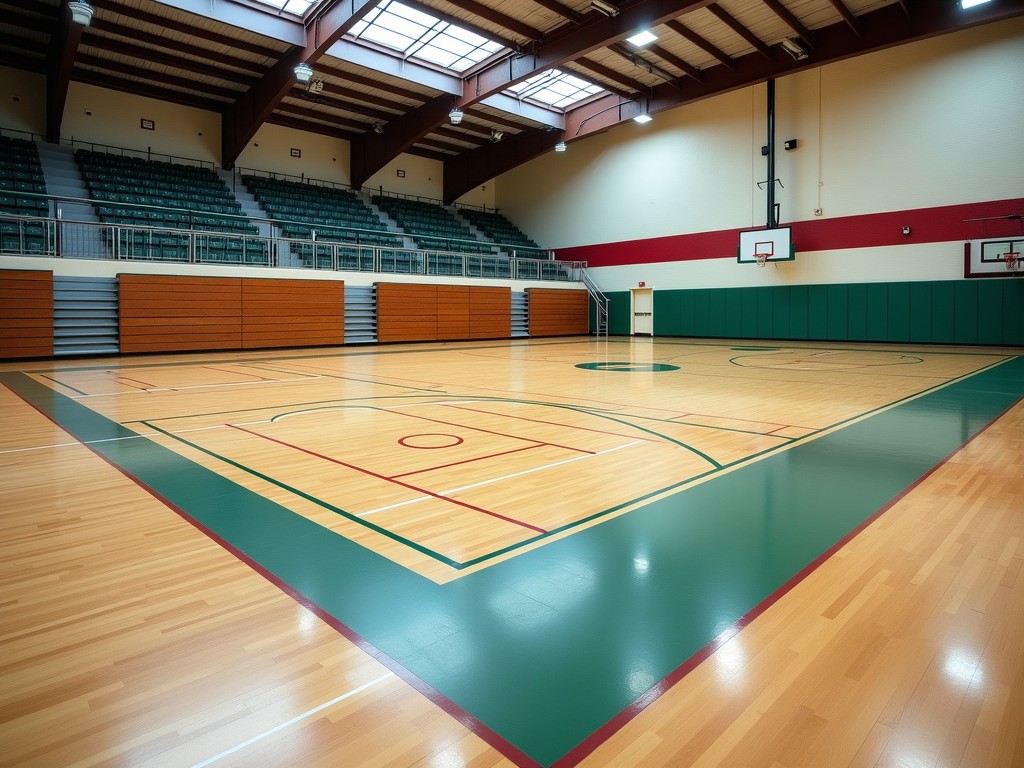
In multi‑sport halls, the floor must support rapid load changes from jumping, lateral slides, and equipment rolling. The interlocking system distributes point loads across adjacent tiles, limiting localized deformation to < 0.2 mm under a 500 N point load. The Shore A hardness and texture combination yields a ball rebound efficiency of 90 % ± 3 % for basketballs, meeting FIBA indoor court requirements, while the coefficient of friction (wet) stays above 0.6, reducing slip risk.
Manufacturing Process and Quality Control
Tiles are injection‑molded on 250‑ton hydraulic presses with cavity pressure held at 120 ± 5 bar. Dimensional inspection uses coordinate‑measuring machines (± 0.05 mm tolerance on thickness, ± 0.1 mm on interlock features). Each batch undergoes a Charpy impact test (minimum 30 J/m) and a accelerated weathering cycle (150 h UV‑B) to verify color stability (ΔE < 3) and hardness retention (> 85 Shore A after exposure).
Technical Specification Table
| Parameter | Typical Value | Unit | Notes |
|---|---|---|---|
| Thickness | 8 – 20 | mm | Customizable per load requirement |
| Shore A Hardness | 88 ± 2 | – | ASTM D2240 |
| Tensile Strength | ≥ 15 | MPa | ASTM D638 |
| Impact Attenuation (G‑max) | < 120 | g | ASTM F355, 12 mm tile |
| Ball Rebound Efficiency | 90 ± 3 | % | FIBA basketball standard |
| Coefficient of Friction (wet) | ≥ 0.6 | – | ASTM E303 |
Installation Guidelines
Subfloor must be flat within 3 mm over a 2 m span, clean, and dry. Tiles are laid dry‑fit, starting from a corner, with a 5 mm expansion gap maintained around perimeter walls using flexible spacers. No adhesive is required; however, a double‑sided tape may be applied at edges for temporary positioning during large‑area rolls. After layout, a perimeter roller (≤ 50 kg) is passed over the surface to ensure full engagement of interlocking joints.
Packaging and Logistics
Tiles are stacked in layers of 10 mm thick sheets, interleaved with low‑density polyethylene film, then placed on Euro‑pallets (800 × 1200 mm). Each pallet holds up to 500 kg, secured with stretch wrap and corner braces. Container loading follows ISO 1496‑1 standards, with temperature‑controlled options available for long‑haul shipments to prevent material degradation.
Frequently Asked Questions
- Can dimensions be customized? Yes, thickness, length, and width can be adjusted to meet specific module layouts; tooling adjustments are quoted per project.
- What information is required before quotation? Required details include intended sport(s), load expectations, substrate condition, desired thickness, color, and any logo or line‑mark specifications.
- What materials are available? Base material is polypropylene‑ethylene copolymer; optional additives include UV stabilizers, anti‑static agents, and recycled content blends upon request.
- How is quality inspected? Every production lot undergoes dimensional CMM checks, Shore A hardness, tensile, impact, and accelerated weathering tests; test reports are available on request.
- What packaging methods are available? Standard palletizing with PE film interleave; custom crate or slat‑wall packaging can be arranged for sensitive destinations.
- How are export shipments protected? Pallets are wrapped in UV‑stable stretch film, corner‑protected, and secured with steel straps; desiccant packs are included for humidity control.
- What is the typical production lead time? Lead time ranges from 3 to 4 weeks after final artwork approval, depending on order size and customization complexity.
- How are samples arranged? Sample kits (up to 4 tiles) are shipped via express courier; costs are credited against the first order.
Request for Quotation
To discuss your specific multi‑sport flooring requirements, provide your project details and we will return a detailed quote including tooling, lead time, and logistics options. Contact us to begin the consultation.