Custom Durable Gray Interlocking Floor Tiles Supplier
Custom Durable Gray Interlocking Floor Tiles Supplier
Custom Durable Gray Interlocking Floor Tiles
Product Overview
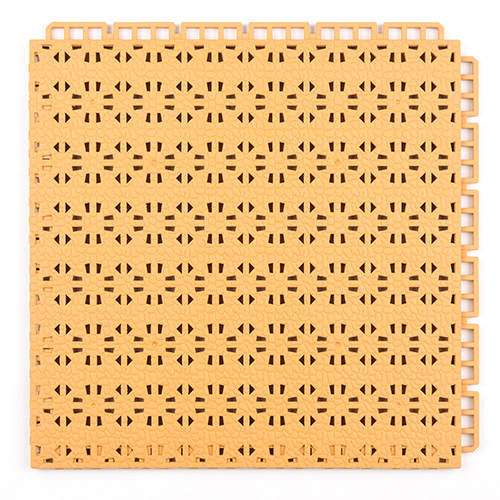
These interlocking tiles are engineered for industrial floors where durability, chemical resistance, and ease of installation are critical. Each unit measures 600 mm × 600 mm with a nominal thickness of 20 mm, providing a compressive strength of ≥ 45 MPa and an abrasion loss of ≤ 0.15 g per 1000 cycles under Taber testing.
The tongue‑and‑groove profile creates a mechanical lock that resists lateral displacement under dynamic loads up to 10 kN per tile, eliminating the need for adhesives in most installations.
Material Composition
The tile body consists of a high‑density polypropylene copolymer filled with 30 % glass‑filled mineral reinforcement, delivering a flexural modulus of approximately 3.5 GPa. A UV‑stabilized pigment package provides a consistent gray (RAL 7042) finish that retains color stability after 1000 hours of UV exposure per ISO 4892‑2.
Additives include a proprietary anti‑static agent (≤ 0.5 % by weight) and a flame‑retardant package meeting UL‑94 V‑2 classification.
Technical Specifications
| Property | Typical Value | Test Method |
|---|---|---|
| Dimensions (L × W × H) | 600 mm × 600 mm × 20 mm | ISO 2768‑1 |
| Compressive Strength | ≥ 45 MPa | ASTM D695 |
| Flexural Modulus | ≈ 3.5 GPa | ASTM D790 |
| Abrasion Resistance (Taber) | ≤ 0.15 g/1000 cycles | ASTM D4060 |
| Chemical Resistance (ISO 2812‑1) | No swelling after 7 days immersion in 10 % NaOH, 10 % H₂SO₄, oil | ISO 2812‑1 |
| Temperature Range | ‑30 °C to +80 °C (continuous) | Internal testing |
| Interlock Shear Capacity | ≥ 10 kN per tile | ISO 148‑1 (notched impact) |
Customization Options
While the standard tile is gray (RAL 7042) and 20 mm thick, the manufacturing process allows adjustments to meet project‑specific requirements.
- Thickness: 15 mm, 25 mm, or 30 mm (affects load capacity proportionally).
- Color: Custom pigments available; minimum order 500 m² per shade.
- Surface texture: Smooth, light‑scrape, or anti‑slip profile (R ≥ 0.6).
- Edge profile: Standard tongue‑and‑groove or reinforced double‑lock for heavy‑duty racking.
- Additives: Enhanced UV stabilizer, increased flame retardancy (UL‑94 V‑0), or conductive filler for ESD control.
All customizations are quoted based on tooling adjustments and material lead times, typically 4‑6 weeks after approval of technical drawings.
Typical Applications
In automotive assembly plants, the tiles support conveyor loads and resist oil spills, providing a replaceable wear surface that can be lifted and re‑laid without downtime.
Food‑processing facilities benefit from the chemical‑resistant surface and the ability to withstand frequent wash‑down cycles at temperatures up to 80 °C.
Warehouses with high‑rack storage use the reinforced interlock to distribute point loads from pallet racks, reducing floor cracking compared with poured concrete.
Pharmaceutical cleanrooms select the anti‑static version to meet ISO 14644‑1 Class 7 requirements while maintaining ease of cleaning.
Quality Control Philosophy
Each production batch undergoes dimensional inspection on a coordinate measuring machine (CMM) with a tolerance of ± 0.2 mm on length and width and ± 0.1 mm on thickness.
Mechanical properties are verified on every 500 m² lot using compressive and flexural test rigs; results are logged and traceable to the batch number.
Visual inspection for color uniformity and surface defects is performed under standardized D65 lighting; any tile exceeding ΔE > 2 is rejected.
Final packaging includes a QR code linking to the batch’s test certificate, enabling customers to verify compliance upon receipt.
Packaging & Shipping
Tiles are stacked in layers of 10 mm polyethylene sheets, then placed in corrugated cardboard cartons sized to hold 1 m² (approximately 3 tiles). Each carton is banded with polypropylene strapping and labeled with part number, quantity, and batch code.
For full‑truckload shipments, cartons are palletized on 1200 mm × 1000 mm heat‑treated pallets, stretch‑wrapped, and secured with corner boards. Export containers receive additional desiccant packs to maintain humidity below 60 % RH.
Lead time from order confirmation to ex‑factory shipment is typically 3‑4 weeks for standard configurations; custom orders add 2‑3 weeks for tooling and material procurement.
Frequently Asked Questions
Can dimensions be customized?
Yes. Length and width can be adjusted in 50 mm increments; thickness options are 15 mm, 20 mm, 25 mm, and 30 mm. Custom sizes require a new mold and are subject to minimum order quantities.
What information is needed for a quotation?
Project area, desired thickness, color or pigment reference, any special additives (UV, flame retardant, ESD), and required delivery date.
How is quality inspected?
Dimensional checks via CMM, mechanical testing per lot, and visual color assessment under D65 lighting; all data are recorded and supplied with the shipment.
What packaging methods are available?
Standard carton packing, palletized stretch‑wrapped loads, and custom crate options for overseas project shipments.
How are export shipments protected?
Cartons are placed on heat‑treated pallets, wrapped with UV‑stable stretch film, and include desiccant packs; corner boards protect edges during handling.
What is the typical production lead time?
Standard tiles: 3‑4 weeks. Custom colors/thicknesses: additional 2‑3 weeks for tooling and material prep.
Contact Us
For technical inquiries, customization requests, or a formal quotation, please reach out to our engineering team.
Request a Quote