China Black And White Interlocking Floor Tiles Supplier
China Black And White Interlocking Floor Tiles Supplier
China Black and White Interlocking Floor Tiles Supplier
Product Overview
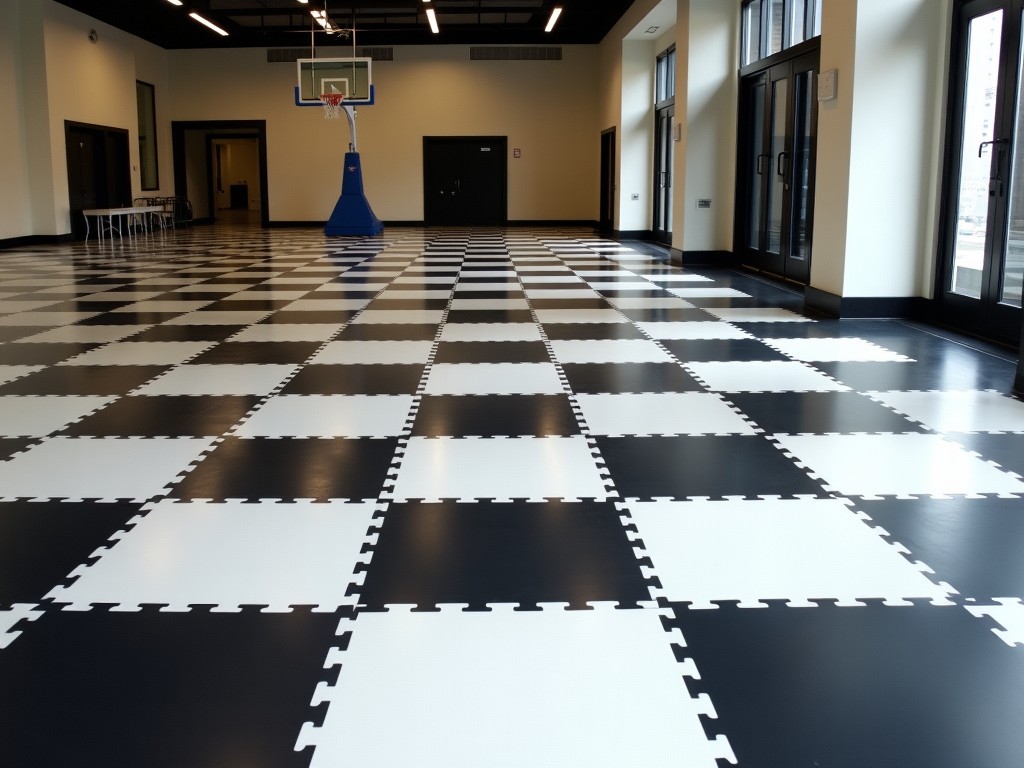
Interlocking floor tiles are modular units that connect without adhesives or fasteners, forming a continuous surface through precision‑mated edges. The black and white variant offers a contrasting visual pattern suitable for environments where clear demarcation or aesthetic contrast is required. These tiles are manufactured from high‑density polypropylene or PVC compounds, selected for impact resistance and dimensional stability under varying loads.
Material Composition and Performance
The base polymer is typically a copolymer blend that provides a flexural modulus ranging from 1,200 to 1,800 MPa, ensuring sufficient stiffness to resist deformation under point loads while retaining enough flexibility to accommodate minor sub‑floor irregularities. Additives include UV stabilizers for outdoor exposure and antimicrobial agents for hygienic settings such as food processing or healthcare facilities. The surface finish is engineered to a coefficient of friction between 0.5 and 0.6 (dry condition) to reduce slip risk without excessive wear.
Thermal expansion coefficient of the polymer matrix is approximately 6×10⁻⁵ /°C, which allows the tiles to accommodate temperature fluctuations up to ±30 °C without joint locking or gaps. Water absorption is below 0.1 % by weight, making the product suitable for wet areas where prolonged moisture contact occurs. These characteristics are verified through ASTM D638 (tensile) and ASTM D695 (compressive) testing protocols on representative samples.
Interlocking Mechanism Design
Each tile features a male‑female edge system with a tongue‑and‑groove geometry that engages under a compressive force of roughly 150 N per linear edge, sufficient to prevent lateral movement under typical foot traffic loads. The interlock includes a secondary latch rib that provides an additional shear resistance of about 30 N, enhancing stability in vibration‑prone environments such as workshops with heavy machinery.
- Self‑aligning tabs reduce installation time by eliminating the need for precise manual alignment.
- Edge chamfers prevent chipping during handling and allow for slight mis‑fit compensation.
- Optional locking clips are available for applications requiring extra security against uplift forces.
Typical Applications
In automotive assembly plants, the tiles are placed in paint booth corridors where chemical resistance to solvents and ease of cleaning are critical; the black‑white pattern helps delineate safe walkways from equipment zones. Warehouse logistics centers use the flooring in loading docks to provide a durable surface that can withstand pallet jack impacts while the contrasting colors improve visibility for traffic flow direction. Pharmaceutical cleanrooms benefit from the antimicrobial additive and low particle shedding, meeting ISO Class 7‑8 floor requirements when paired with proper sealing protocols.
Educational institutions install these tiles in multipurpose halls where quick reconfiguration is needed for events; the interlocking system allows removal and reinstallation without damaging the sub‑floor. Retail environments leverage the aesthetic contrast to create visual merchandising zones that can be altered seasonally. Outdoor sports facilities select UV‑stabilized versions for perimeter pathways, where slip resistance and drainage are essential.
Technical Specifications
| Property | Typical Value | Test Method / Note |
|---|---|---|
| Material Base | Polypropylene / PVC copolymer | Supplier data sheet |
| Density | 0.90–0.96 g/cm³ | ASTM D792 |
| Flexural Modulus | 1,200–1,800 MPa | ASTM D790 |
| Coefficient of Friction (dry) | 0.5–0.6 | ASTM D2047 |
| Water Absorption | <0.1 % | ASTM D570 |
| Thermal Expansion | 6×10⁻⁵ /°C | ASTM D696 |
| Impact Resistance (Izod) | ≥150 J/m | ASTM D256 |
| Standard Tile Size | 300 mm × 300 mm × 8 mm | Custom sizes available |
| Weight per Tile | ≈0.65 kg | Calculated from density |
Quality Control Process
Raw material lots are inspected for melt flow index and additive concentration before extrusion; deviations beyond ±5 % trigger rejection. During production, inline laser gauges monitor tile thickness and edge profile at 0.01 mm resolution, with automatic feedback to the extruder to maintain tolerance within ±0.1 mm. Finished tiles undergo a batch‑wise pull‑test on a sampling rate of 1 % to verify interlock strength, and a random 0.5 % sample is subjected to accelerated aging (UV + humidity) for 500 hours to assess color stability and mechanical retention.
Visual inspection is performed under standardized lighting (D65) to detect surface defects such as scratches, inclusions, or color streaks; any tile exceeding a defect size of 0.5 mm is segregated. Documentation of each inspection step is retained for traceability, and a certificate of conformance can be provided upon request, detailing the specific test results for the shipped lot.
Customization Options
- Tile dimensions: length and width adjustable from 200 mm to 600 mm in 50 mm increments; thickness options 6 mm, 8 mm, 10 mm.
- Color ratios: custom black‑white patterns, including stripes, checkerboards, or gradient blends achievable through co‑extrusion.
- Surface treatments: anti‑static coating, increased friction grit, or smooth low‑resist finish.
- Edge modifications: reinforced latch for heavy‑duty loads, or reduced‑profile edges for tight‑fit installations.
- Packaging: palletized with corner protectors, shrink‑wrapped, or placed in reusable crates for overseas shipment.
Packaging and Shipping
Tiles are stacked in layers separated by corrugated dividers to prevent edge chipping during transit. A standard pallet holds 480 tiles (assuming 300 mm × 300 mm size), resulting in a pallet weight of approximately 310 kg, which is within the safe handling limits for forklift operations. Export shipments are secured with stretch film and corner boards, and the pallets are marked with handling symbols indicating “keep dry” and “avoid direct sunlight” to preserve material properties until installation.
Lead time for standard configurations ranges from 2 to 4 weeks after receipt of a confirmed purchase order, depending on order volume and current production schedule. Custom colors or dimensions may extend the timeline by an additional 1–2 weeks to accommodate tooling adjustments and material procurement. Shipping terms are typically FOB Ningbo or Shanghai, with options for CIF or DDP upon request.
Frequently Asked Questions
Can dimensions be customized to match existing modular grids?
Yes, tile length and width can be adjusted in 50 mm increments to align with common module sizes such as 400 mm or 600 mm grids. Custom tooling is required for sizes outside the standard range, and the associated lead time and tooling costs will be provided upon request.
What information is needed before a quotation can be issued?
To generate an accurate quote, we require the desired tile dimensions, thickness, color pattern (black‑white ratio or custom artwork), surface treatment preferences, quantity, and delivery destination. If the project involves special load or chemical resistance requirements, please specify the relevant standards (e.g., ASTM, ISO) so we can recommend appropriate material grades.
How is product quality verified before shipment?
Each production lot undergoes dimensional checks, interlock strength testing, and visual inspection as described in the quality control section. A batch certificate of conformance, summarizing test results, is available for review before dispatch. Third‑party inspection can be arranged at the customer’s expense if independent validation is required.
What packaging methods protect the tiles during long‑distance transport?
Tiles are packed in layers with corrugated separators, then placed on pallets secured with stretch film and corner boards. For overseas shipments, additional moisture‑barrier bags and desiccant packs can be included upon request to mitigate humidity exposure during transit.
Next Steps
If you would like to discuss technical details, request a sample, or obtain a formal quotation, please use the contact form below. Our engineering team will review your specifications and respond with feasible options and lead‑time estimates.
Request a quotation