Ce Certified Smooth Interlocking Floor Tiles Company
Ce Certified Smooth Interlocking Floor Tiles Company
CE‑Certified Smooth Interlocking Floor Tiles
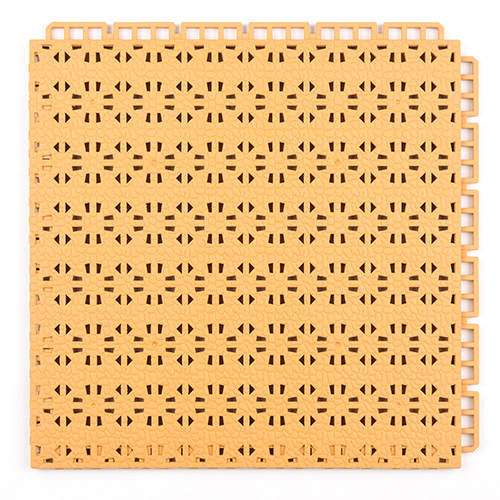
The tiles are manufactured from a homogeneous polypropylene copolymer formulated for high impact resistance and low moisture absorption. Standard thickness options range from 6 mm to 10 mm, with a nominal weight of 4.2 kg/m² at 8 mm thickness. The surface finish is specified as Ra < 0.8 µm to facilitate cleaning and reduce particle retention.
Product Overview
Interlocking edges consist of a male‑female tab system engineered to withstand shear loads of up to 1.8 kN per joint without disengagement. The interlock geometry provides a lateral tolerance of ±0.5 mm, allowing rapid alignment during installation while maintaining a seamless surface.
Technical Specifications
Key performance parameters are determined through standardized testing and are presented below for the 8 mm thick variant.
| Parameter | Typical Value | Unit | Test Standard |
|---|---|---|---|
| Compressive strength | 2.5 | MPa | ISO 604 |
| Slip resistance (wet) | 0.45 | Coefficient of friction | EN 13893 |
| Temperature range | -20 to +80 | °C | Internal |
| Chemical resistance (oil) | No swelling after 24 h immersion | — | ASTM D543 |
Interlock Mechanism
Each tile features a reinforced polypropylene lug on one side and a corresponding recess on the opposite side. The lug incorporates a 0.3 mm stainless‑steel insert to prevent creep under sustained load. Engagement force is measured at 120 N per tile, ensuring a secure fit without the need for adhesives or mechanical fasteners.
Installation Procedure
Installation follows a dry‑lay method that reduces downtime and eliminates curing times.
- Prepare a clean, level substrate; verify flatness within ±3 mm over 2 m.
- Start at a reference wall, laying the first row with the male edge facing outward.
- Press each subsequent tile firmly until the interlock clicks, confirming full engagement.
- Cut edge tiles using a fine‑tooth saw to maintain a 2 mm expansion gap at perimeter.
- Roll the completed area with a 50 kg pneumatic roller to achieve uniform load distribution across joints.
Application Suitability
In food processing facilities, the smooth, non‑porous surface minimizes bacterial harborage and withstands frequent wash‑downs with alkaline detergents at 80 °C. Automotive assembly lines benefit from the tile’s ability to support static loads of up to 5 t/m² while resisting oil and coolant splatter. Warehouse environments value the low‑vibration transmission and the ease of re‑configuring layouts without damaging the substrate.
Quality Assurance & Certification
All tiles carry CE marking conforming to the Machinery Directive 2006/42/EC and the Low Voltage Directive 2014/35/EU. Batch testing includes slip resistance (EN 13893), abrasion loss (ISO 5470‑1), and dimensional stability (ISO 2577). Traceability is maintained via laser‑etched lot numbers on the underside of each tile.
Customization Options
Customers may specify thickness from 6 mm to 12 mm, surface textures ranging from smooth to light‑grip (Ra ≈ 1.5 µm), and a palette of 12 standard colors with optional antimicrobial additive (silver‑ion) at 0.02 wt %. Edge trim profiles are available in PVC or aluminum to accommodate expansion joints and transitions to other flooring systems.
Packaging & Logistics
Tiles are stacked in layers of 10 mm thickness, interleaved with low‑density polyethylene film, and placed on Euro‑pallets (800 mm × 1200 mm). A standard pallet holds 200 kg of product, corresponding to approximately 48 m² at 8 mm thickness. Pallets are stretch‑wrapped and secured with corner boards for containerized shipment.
Ordering & Lead Time
Minimum order quantity is 50 m² for stocked colors; custom colors or thicknesses require a minimum of 200 m². Sample tiles (up to 2 m²) can be dispatched within 3 working days upon receipt of a formal request. Production lead time for standard configurations averages 10 working days, while customized orders typically require 18‑22 working days depending on tooling availability.
Get a Quote
To discuss technical specifications, obtain a formal quotation, or arrange sample shipment, Contact our technical team for prompt assistance.