Bulk Esd Interlocking Sports Floor Tiles Exporter
Bulk Esd Interlocking Sports Floor Tiles Exporter
Bulk ESD Interlocking Sports Floor Tiles Exporter
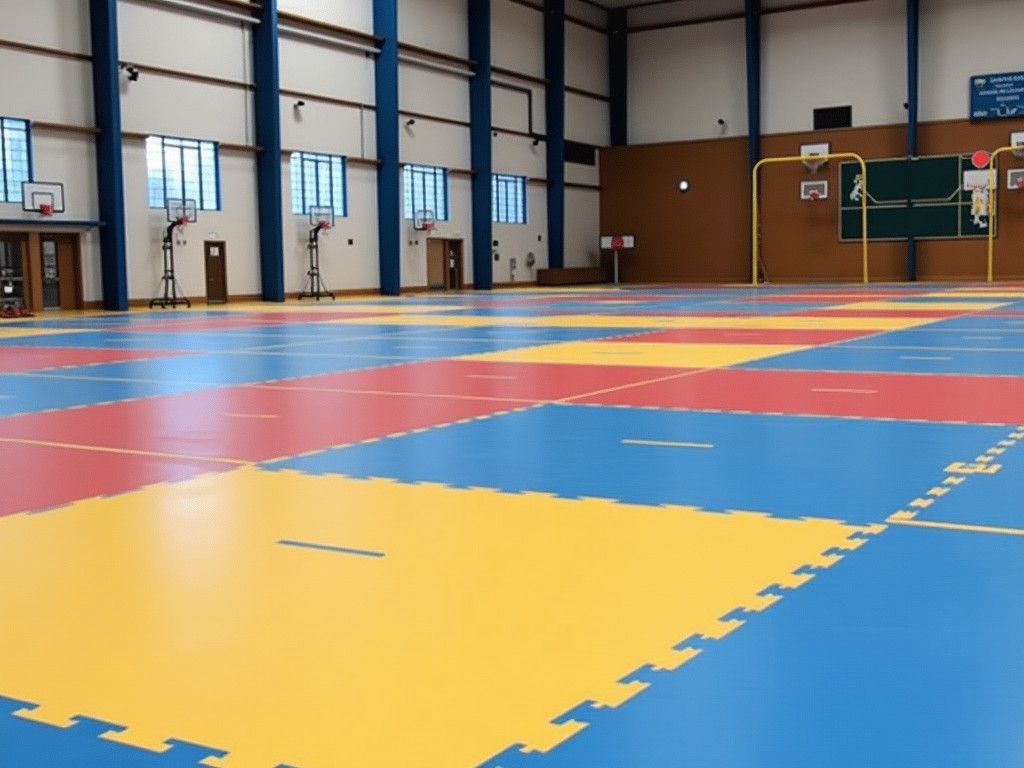
These tiles combine a conductive polymer matrix with a mechanical interlocking edge, providing a continuous dissipative path while allowing rapid installation and removal.
Typical thickness ranges from 6 mm to 12 mm, with standard module dimensions of 300 mm × 300 mm or 600 mm × 600 mm, depending on load requirements.
Technical Specifications
| Property | Typical Value | Test Standard |
|---|---|---|
| Volume Resistance | 10⁶ – 10⁹ Ω·cm | ASTM D257 |
| Surface Resistance | 10⁵ – 10⁸ Ω | ANSI/ESD S20.20 |
| Compressive Strength | ≥ 2.5 MPa (at 10 % strain) | ISO 604 |
| Impact Absorption | ≥ 30 % energy return (ASTM F355) | ASTM F355 |
| Thermal Conductivity | 0.20 W/(m·K) (typical) | ISO 8302 |
Values are representative; actual performance can be tailored by adjusting conductive filler loading and polymer grade.
Applications and Suitability
In electronics assembly zones, the tiles provide a grounded path that prevents static accumulation on personnel and equipment, reducing the risk of latent defects.
Sports facilities benefit from the shock‑absorbing layer, which lowers joint stress during high‑impact activities while maintaining an ESD‑safe environment for embedded timing systems or sensor arrays.
Cleanroom‑adjacent areas use the low‑outgassing formulation to meet ISO Class 7‑8 particulate limits, and the seamless interlock prevents particle traps at joints.
- Electronics manufacturing lines (SMT, PCB test)
- Automotive electronic control units
- Data center raised floors with ESD requirements
- Multi‑purpose sports halls with embedded scoring systems
Key Advantages (Quantitative)
- Volume resistance controllable within one decade via filler percentage (e.g., 5 wt% carbon black yields ~10⁷ Ω·cm).
- Interlock shear strength ≥ 1.2 kN per tile, ensuring floor integrity under dynamic loads.
- Weight per tile ≈ 2.8 kg (6 mm thickness), facilitating manual handling and reducing installation time.
- Fire rating: UL‑94 V‑0 achievable with halogen‑free flame retardant additives.
Quality Control Philosophy
Each production lot undergoes inline resistance testing at four points per tile, with statistical process control targeting a Cp ≥ 1.33 for volume resistance.
Dimensional verification uses laser scanning to confirm interlock pitch tolerance of ±0.15 mm, preventing gaps that could compromise continuity.
Visual inspection follows a 10× magnification standard to detect surface contaminants or incomplete cure.
Customization Options
Buyers can specify tile thickness, module size, surface texture, and conductive filler type to match site‑specific electrical and mechanical demands.
- Thickness: 4 mm – 20 mm (in 2 mm increments)
- Module size: 200 mm × 200 mm up to 800 mm × 800 mm
- Surface finish: smooth, textured anti‑slip, or coated with wear‑resistant PU
- Conductive filler: carbon black, graphite, or intrinsic conductive polymer (adjustable volume resistivity)
- Color: standard gray, black, or custom RAL matching
Packaging and Export Logistics
Tiles are stacked in layers with polyethylene sheets between layers to prevent abrasion, then unitized on heat‑treated pallets (1000 mm × 1200 mm) and stretch‑wrapped.
A moisture‑barrier liner is included for ocean shipments, and each pallet carries a clearly marked ESD handling label.
Standard container load: 22 pallets per 40‑ft HQ, approximating 18 tonnes depending on tile thickness.
Frequently Asked Questions
Can dimensions be customized?
Yes. Both thickness and planar dimensions are adjustable per project; tooling lead time is typically 3‑4 weeks for new sizes.
What information is required before quotation?
Required data include: desired electrical resistance range, expected load (point and uniform), environmental conditions (temperature, humidity, chemical exposure), and any certification needs (e.g., UL, CE).
How is quality inspected?
Every batch receives resistance sampling, dimensional laser scan, and visual inspection per internal QC‑01 standard; test reports are available upon request.
What packaging methods are available?
Options include palletized stretch‑wrap, cardboard‑boxed cartons for smaller orders, or custom crating for high‑value items.
How are export shipments protected?
Shipments use moisture‑barrier bags, corner protectors, and ISO‑compliant palletizing to minimize shifting and damage during transit.
What is the typical production lead time?
Lead time ranges from 2‑3 weeks for standard configurations to 5‑6 weeks for customized thicknesses or filler blends.
How are samples arranged?
Sample sets (up to 4 tiles) can be dispatched via express courier with freight charges collect or prepaid, subject to availability.
For technical inquiries, pricing, or to request a formal quotation, please contact our export department.
Request Quote