Best Price Interlocking Flexible Floor Tiles Factory
Best Price Interlocking Flexible Floor Tiles Factory
Best Price Interlocking Flexible Floor Tiles – Factory Direct
Product Overview
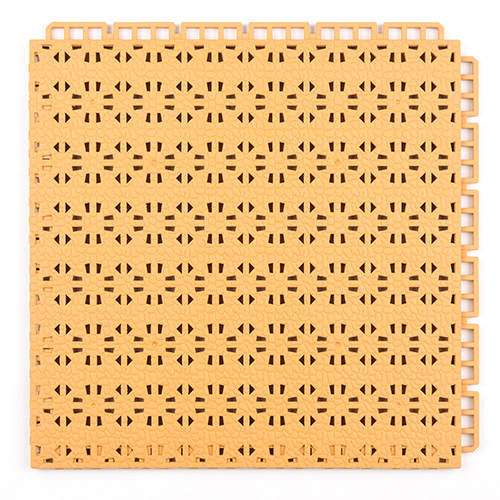
Interlocking flexible floor tiles are manufactured from thermoplastic elastomer compounds that provide a resilient surface capable of absorbing impact while maintaining dimensional stability under load. The tiles feature a male‑female edge profile that snaps together without adhesives, allowing rapid installation and disassembly for reconfiguration or maintenance.
Technical Specifications
| Parameter | Typical Value | Test Method |
|---|---|---|
| Tile Thickness | 12 mm ±0.5 mm | ISO 24340 |
| Shore A Hardness | 85 ± 3 | ASTM D2240 |
| Tensile Strength | 4.2 MPa minimum | ISO 37 |
| Compressive Strength @ 10 % strain | 1.8 MPa | ASTM D575 |
| Temperature Resistance | ‑30 °C to +80 °C (continuous) | Internal cycling test |
| Chemical Resistance | No degradation after 24 h exposure to oils, solvents, alkaline cleaners | ISO 2812‑1 |
| Interlock Shear Strength | 0.9 MPa (edge joint) | ASTM D638 modified |
Material Composition
The tile body consists of a thermoplastic vulcanizate (TPV) blend containing approximately 70 % ethylene‑propylene‑diene monomer (EPDM) rubber phase dispersed in a polypropylene matrix. This composition yields high elasticity, UV stability, and resistance to abrasion. Additives include antioxidant packages and UV stabilizers to extend service life in indoor and semi‑outdoor environments.
Interlocking Mechanism & Installation
Each tile incorporates a reinforced male tongue and female groove with a 2 mm interference fit. The interlock is designed to resist lateral shear forces up to 0.9 MPa while allowing vertical movement to accommodate substrate unevenness. Installation requires no tools; tiles are pressed together by hand or with a rubber mallet, achieving full engagement after a 5 mm compression of the joint.
Subfloor preparation involves cleaning, leveling to within ±3 mm over a 2 m span, and ensuring dry conditions. A vapor barrier may be applied where moisture transmission exceeds 5 g/m²/24 h.
Performance Characteristics
- Impact attenuation: reduces peak force by 45 % compared to bare concrete under a 5 kg steel ball drop from 1 m.
- Slip resistance: dynamic coefficient of friction ≥0.6 (wet) per ASTM E303.
- Acoustic insulation: improves impact sound insulation by 12 dB (ISO 10140‑3).
- Load distribution: point load of 2 kN spreads over 150 mm² without permanent deformation.
- Dimensional stability: length change <0.1 % after 500 h at 70 °C/80 % RH.
Applications
In manufacturing facilities, the tiles protect concrete substrates from heavy tool drops and provide ergonomic comfort for assembly line workers standing for extended periods. Their resistance to oils and coolants makes them suitable for machining zones where fluid spillage is common.
Warehouses and distribution centers benefit from the tile’s ability to withstand pallet jack traffic while providing a modular surface that can be lifted for floor inspections or conduit replacement. The interlocking design allows rapid reconfiguration of storage layouts without downtime.
Automotive showrooms and service bays use the tiles to present a clean, slip‑resistant finish that tolerates occasional fuel exposure and facilitates quick cleanup after maintenance procedures.
Quality Assurance & Testing
Each production batch undergoes incoming material verification for melt flow index and rubber content, followed by in‑process checks of tile thickness and interlock dimensions using laser micrometers. Finished tiles are sampled for tensile, hardness, and compression tests per the table above. Visual inspection confirms absence of flash, surface blemishes, or color variation beyond ΔE < 2.
Statistical process control charts monitor key parameters; any deviation beyond ±2σ triggers a machine stop and root‑cause analysis before resuming.
Customization Options
Tile dimensions can be adjusted from 300 mm × 300 mm to 600 mm × 600 mm in 50 mm increments while preserving the interlock geometry. Surface patterns include smooth, ribbed, or coin‑grid textures to meet specific slip or aesthetic requirements.
Color matching is available using Pantone or RAL references; pigments are dispersed uniformly during compounding to avoid streaking. Custom logos can be embossed on the tile face using a recessed mold, providing wear‑resistant branding.
Packaging & Shipping
Tiles are stacked in layers of 10 mm thick corrugated cardboard sheets, then placed on Euro‑pallets (1200 mm × 800 mm) with a maximum load of 1 tonne per pallet. Edge protectors and stretch film secure the load, preventing movement during transit.
Each pallet bears a label indicating SKU, batch number, quantity, and handling instructions. For export, fumigation‑treated pallets and ISPM‑15 compliant marking are provided upon request.
Lead Time & Sampling
Standard inventory items ship within 5 working days after receipt of purchase order. Custom sizes, colors, or embossing require 15‑20 working days for tooling preparation and production.
Free sample kits (up to four tiles) are available to qualified buyers; shipping costs are covered by the requestor. Sample requests should include intended application and any required specifications.
Frequently Asked Questions
- Can dimensions be customized? Yes, length and width can be adjusted in 50 mm increments; thickness remains 12 mm unless otherwise quoted.
- What information is required before quotation? Required details include tile size, quantity, surface finish, color or Pantone reference, any logo embossing, and delivery destination.
- What materials are available? Standard TPV (EPDM/PP blend); optional additives for enhanced UV or flame retardancy can be discussed.
- How is quality inspected? Each lot undergoes dimensional, mechanical, and visual checks per ISO 9001‑based procedures; test certificates are supplied with shipment.
- What packaging methods are available? Standard palletized cartons; custom crating or bulk bags can be arranged for specific handling needs.
- How are export shipments protected? Pallets are heat‑treated, wrapped in stretch film, and fitted with corner boards; fumigation certificates are provided on request.
- What is the typical production lead time? Stock items: 5 days; customized orders: 15‑20 days after artwork approval.
- How are samples arranged? Email or portal request with application details; samples dispatched within 2 working days.
Contact for Inquiry
To obtain a formal quotation, technical data sheet, or to discuss specific project requirements, please reach out via the contact form.
Request Quote & Technical Sheet