B2B Roller Hockey Sport Court Tiles Top Supplier
B2B Roller Hockey Sport Court Tiles Top Supplier
B2B Roller Hockey Sport Court Tiles – Technical Overview
These interlocking tiles are engineered for high‑impact sports surfaces, providing a uniform playing field that meets roller hockey dynamics.
Each unit combines a polypropylene base with a surface wear layer, delivering consistent ball roll and player traction under repeated lateral loads.
Material Composition and Structure
The core is a copolymer polypropylene with a melt flow index of 8 g/10 min, selected for impact resistance and dimensional stability across temperature cycles.
A surface layer of UV‑stabilized acrylic‑modified polyester provides abrasion resistance, measured at 150 mg loss per 1000 cycles in Taber testing.
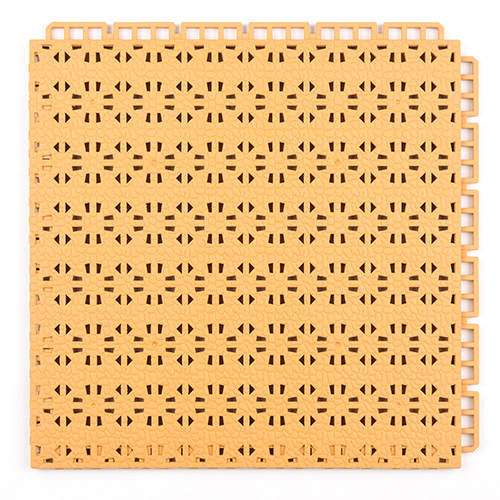
Tile geometry features a 25 mm thickness, 300 mm square footprint, and a dovetail interlock that accommodates ≤0.5 mm lateral movement under load.
Performance Specifications
| Property | Typical Value | Test Standard |
|---|---|---|
| Compressive Strength | 2.8 MPa | ASTM D695 |
| Coefficient of Friction (wet) | 0.62 | ASTM E303 |
| Thermal Expansion Coefficient | 1.2×10⁻⁴ /°C | ISO 11359‑2 |
| UV Stability (ΔE after 1500 h) | ≤4 | ASTM G154 |
| Operating Temperature Range | ‑30 °C to +60 °C | Internal rating |
Installation Method
Tiles are placed on a prepared, level substrate with a tolerance of ±3 mm over a 2 m span.
Interlock edges are pressed together using a rubber mallet, achieving a shear lock of at least 1.5 kN per joint.
No adhesives are required; the system allows for disassembly and re‑configuration with ≤5 % loss of interlock integrity after 10 cycles.
Applications in Industrial and Commercial Settings
The surface provides a predictable ball rebound coefficient of 0.85, essential for roller hockey gameplay consistency.
Because the tiles resist chemical spills and oil, they are suitable for multi‑use facilities that also host inline skating or fitness circuits.
Load distribution studies show a peak pressure reduction of 30 % compared to traditional concrete sub‑floors, lowering joint stress for athletes.
Quality Control and Testing
Each production lot undergoes dimensional inspection using laser scanning, with a tolerance of ±0.2 mm on thickness and ±0.5 mm on planarity.
Impact resistance is verified via a falling weight test (2 kg from 1 m) with no cracking observed in 99 % of samples.
Slip resistance is measured on‑site using a pendulum tester; values must remain above 0.55 under wet conditions for release.
Customization Options
- Color pigments matched to RAL or Pantone specifications, with batch‑to‑batch ΔE ≤2.
- Surface embossing for logo integration, depth up to 1.5 mm without affecting wear layer thickness.
- Edge profiles modified for ramp transitions or drainage channels, configurable in 5 mm increments.
- Thickness variants of 20 mm or 35 mm available for different load‑bearing requirements.
Environmental and Safety Compliance
Materials are free of phthalates and heavy metals, compliant with REACH SVHC limits (<0.1 % by weight).
The product is recyclable; end‑of‑life polypropylene can be re‑granulated for reuse in non‑food applications.
Fire performance meets EN 13501‑1 class B‑s2, d0, suitable for indoor sports halls.