Bulk Indoor Flooring For Table Tennis Room Company
Bulk Indoor Flooring For Table Tennis Room Company
Bulk Indoor Flooring for Table Tennis Rooms
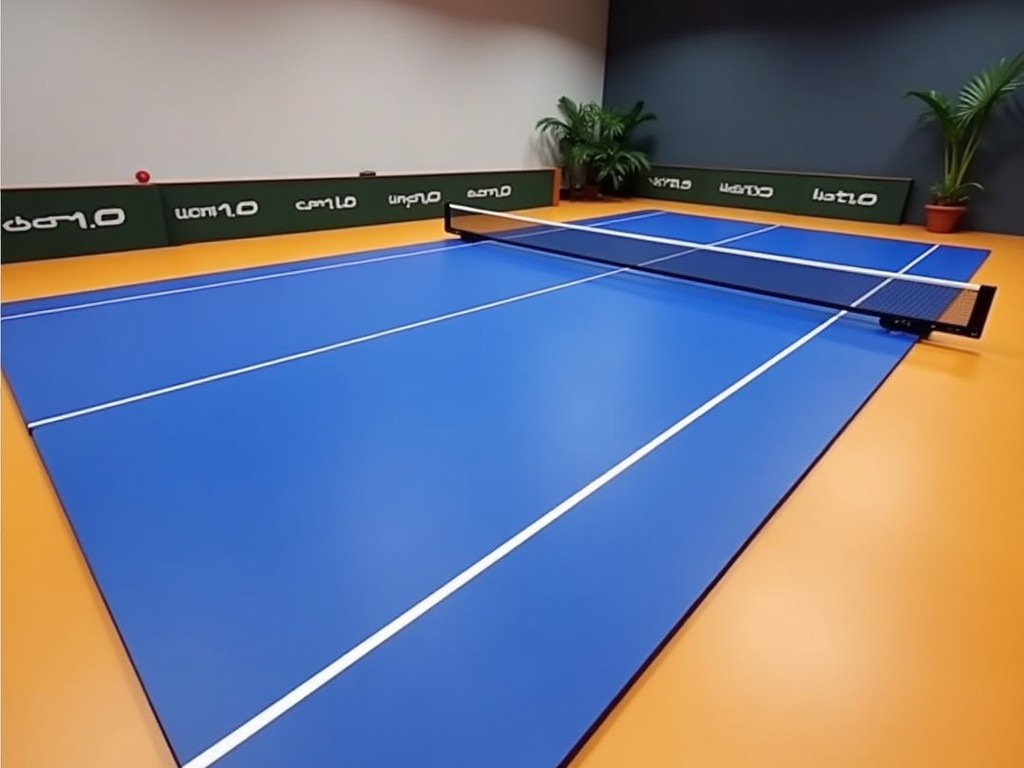
The flooring system is engineered for dedicated table tennis facilities where consistent ball response, player safety, and long‑term surface integrity are critical. It is supplied in roll or tile format for bulk installation, allowing seamless coverage of courts up to several hundred square metres. Each product variant meets the dimensional and performance tolerances referenced in ITTF‑approved playing surfaces.
Construction and Materials
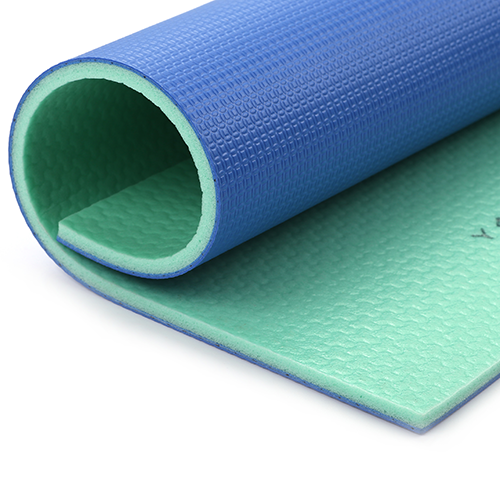
The construction comprises three bonded layers: a polyvinyl chloride (PVC) wear surface, a homogeneous foam underlay, and a reinforced polyester backing. The wear surface is calendered to a uniform thickness of 1.2 mm, providing a low‑glare finish that limits light reflection under typical 500 lux indoor lighting. The foam underlay has a density of 0.045 g/cm³ and a compressive modulus of 150 kPa, contributing to vertical deformation control.
The backing layer incorporates a 0.3 mm glass‑fibre scrim to resist delamination under cyclic loading. All layers are bonded using a solvent‑free polyurethane adhesive that maintains flexibility after curing, allowing the flooring to accommodate sub‑floor movement without cracking.
Technical Specifications
Typical values are derived from laboratory testing according to EN 14904 and ASTM F2772 standards. Actual performance may vary with thickness and backing configuration; custom values are available upon request.
| Property | Value | Test Method |
|---|---|---|
| Overall thickness | 12 mm (±0.5 mm) | ISO 24346 |
| Density (core) | 0.045 g/cm³ | ISO 845 |
| Shore A hardness (wear surface) | 85 | ASTM D2240 |
| Static coefficient of friction | 0.62 | EN 13036‑4 |
| Dynamic coefficient of friction | 0.58 | EN 13036‑4 |
| Vertical deformation (under 500 N) | 0.48 mm | EN 14904 |
| Shock absorption | 30 % | EN 14904 |
| Wear resistance (Taber abrasion, 1000 g load, CS‑10 wheels) | 8000 cycles | ASTM D4060 |
| Fire rating | Bfl‑s1 | EN 13501‑1 |
Performance Benefits
The specified coefficient of friction range (0.58‑0.62) provides sufficient shoe grip for rapid lateral movements while allowing a controlled slide that reduces joint stress. Vertical deformation below 0.5 mm ensures a uniform ball bounce across the entire court, meeting the ITTF tolerance of ±3 mm for rebound height.
Shock absorption of 30 % reduces impact forces transmitted to players’ lower limbs during prolonged play, contributing to fatigue mitigation. The wear layer’s Taber result of 8000 cycles equates to an estimated service life of 8‑10 years under typical foot traffic of 200 persons/day, assuming regular maintenance.
The low‑glare PVC finish minimizes visual distraction under fluorescent or LED lighting, supporting consistent visual tracking of the ball. Fire rating Bfl‑s1 confirms limited flame spread and smoke production, satisfying indoor public venue regulations.
Installation Considerations
- Sub‑floor must be flat to within 3 mm over a 2 m radius, clean, dry, and free of contaminants that could inhibit adhesive bonding.
- A pressure‑sensitive acrylic adhesive is recommended for roll goods; a two‑component polyurethane adhesive is preferred for interlocking tiles in high‑traffic zones.
- Seams should be overlapped by 25 mm and sealed with a compatible PVC welding rod to prevent moisture ingress and seam peaking.
- Expansion gaps of 6 mm around the perimeter and at fixed obstacles accommodate thermal movement; these gaps are covered by removable wall‑base profiles.
Customization Options
- Thickness range: 10 mm to 18 mm, adjustable by varying foam underlay density while keeping wear surface constant.
- Colour palette includes 12 standard shades (e.g., arena blue, tournament green, neutral grey) with custom Pantone matching available for orders exceeding 500 m².
- Surface textures: smooth, fine‑matte, or anti‑slip emboss; each texture alters the coefficient of friction by ±0.03.
- In‑lay options for logo or court markings using UV‑stable PVC inlays, thickness‑matched to the wear layer to avoid height discrepancies.
- Edge profiling: straight, beveled, or rounded, with radius options from 2 mm to 5 mm to suit transition to adjacent flooring.
Quality Control and Testing
Each production lot undergoes inline thickness gauging (±0.1 mm) and Shore A hardness sampling every 50 linear metres. Finished rolls are subjected to accelerated aging (UV‑B 0.68 W/m², 60 °C, 500 h) to verify colour stability and wear resistance retention above 75 % of initial values.
Batch samples are sent to an accredited laboratory for ITTF‑specification compliance, including rebound angle, friction, and shock absorption. Test reports are retained for five years and can be supplied with the shipment documentation.
Traceability is maintained via barcode labels that link roll number to resin batch, extrusion parameters, and QC results, facilitating rapid investigation if a field issue arises.
Applications
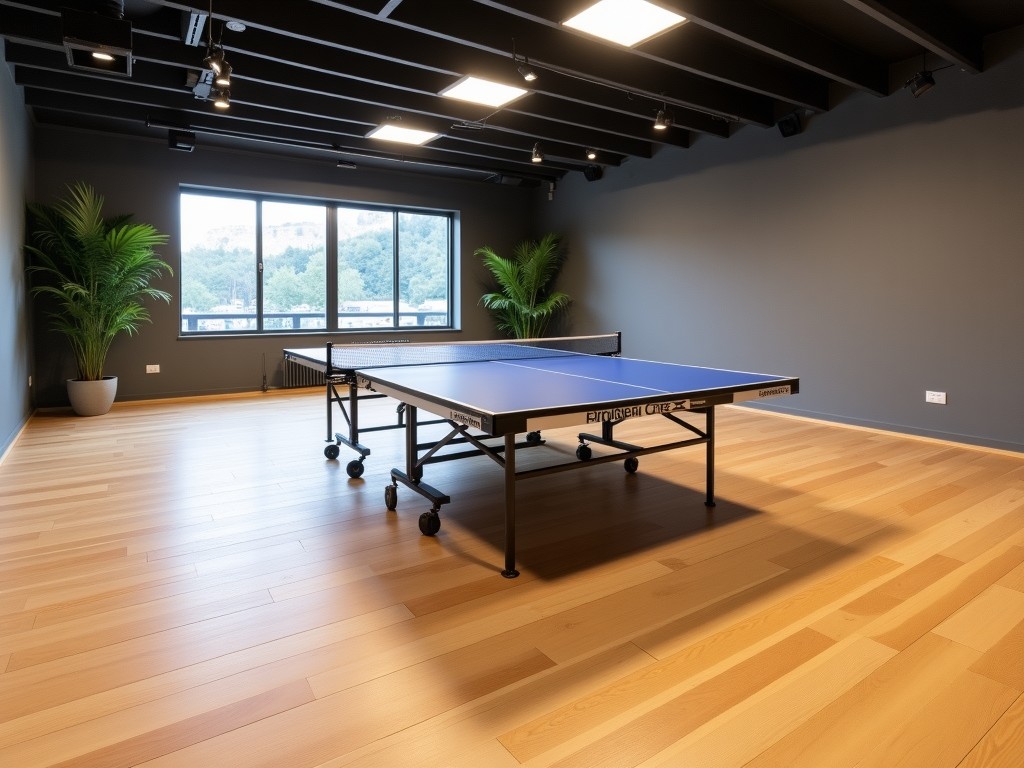
Table tennis rooms require a surface that delivers predictable ball dynamics, minimizes player injury risk, and endures frequent equipment movement. The flooring’s controlled vertical deformation and consistent friction produce a rebound variance under 3 mm across the court, which aligns with the tight tolerances demanded for league and tournament play.
The low‑glare finish reduces visual fatigue for athletes and spectators under high‑intensity lighting, while the shock‑absorbing core attenuates impact forces during rapid foot‑plant and recovery motions. These attributes make the product suitable for multi‑purpose halls that host table tennis alongside other indoor sports, as the surface can be re‑coated or resurfaced without compromising the underlying performance layer.
Frequently Asked Questions
- Can dimensions be customized? Yes. Rolls are available in widths of 1.5 m, 2 m, and 2.5 m with lengths up to 50 m; tiles can be supplied in 300 mm × 300 mm or 500 mm × 500 mm modules, and custom sizes are quoted per project.
- What information is required before quotation? Required data include total area, sub‑floor condition, desired thickness, colour or texture preference, and any special markings (e.g., logos, line tapes).
- What materials are available? The wear surface is PVC; the core can be expanded polystyrene, polyurethane foam, or recycled rubber blends, each offering different density and shock‑absorption values.
- How is quality inspected? Every roll undergoes dimensional checks, hardness testing, and Taber abrasion sampling; batch‑level compliance with ITTF standards is verified by third‑party labs.
- What packaging methods are available? Rolls are wrapped in polyethylene film and placed on corrugated pallets; tiles are packed in cardboard boxes with corner protectors, all designed for stackable transport and moisture resistance.
- How are export shipments protected? Pallets are strapped and corner‑reinforced, then shrink‑wrapped; a desiccant packet is included in each package to limit humidity ingress during transit.
- What is the typical production lead time? Standard colours ship within 10‑12 working days after receipt of confirmed purchase order and artwork; custom colours or textures add 5‑7 days.
- How are samples arranged? Full‑size sample tiles (300 mm × 300 mm) or 300 mm × 300 mm roll sections can be dispatched via express freight; sample fees are credited against the first order.
Next Steps
For detailed specifications, layout assistance, or to request a formal quotation, please contact our technical sales team.
Request a Quote