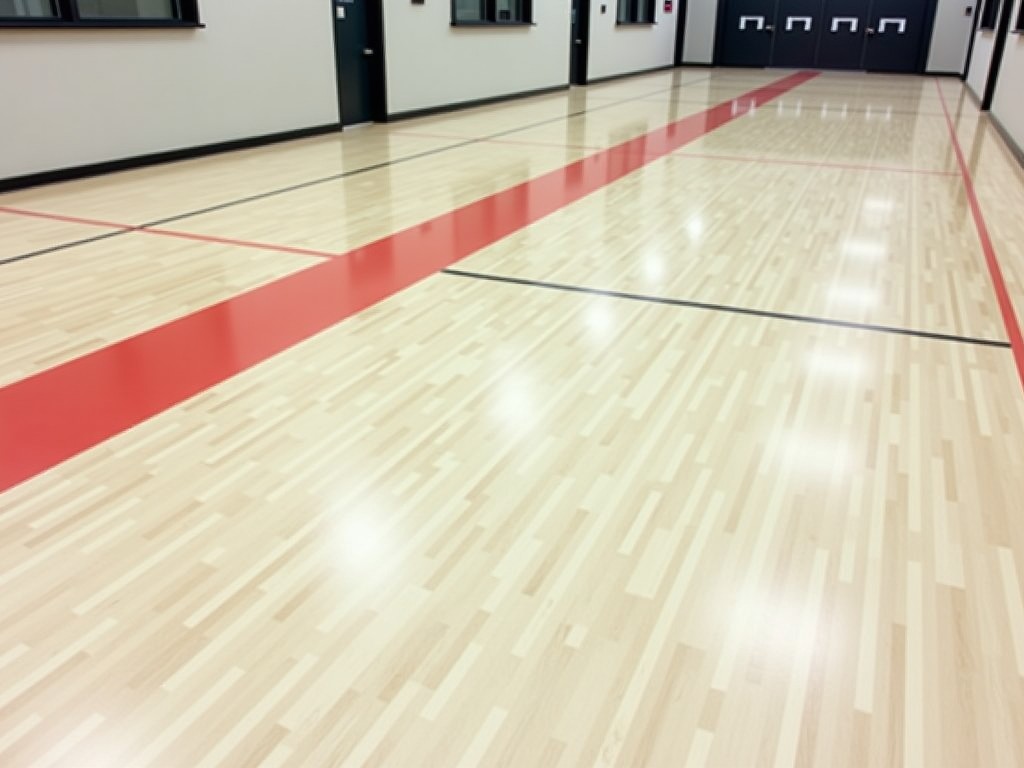
Custom Vinyl Sports Gym Flooring Top Factory
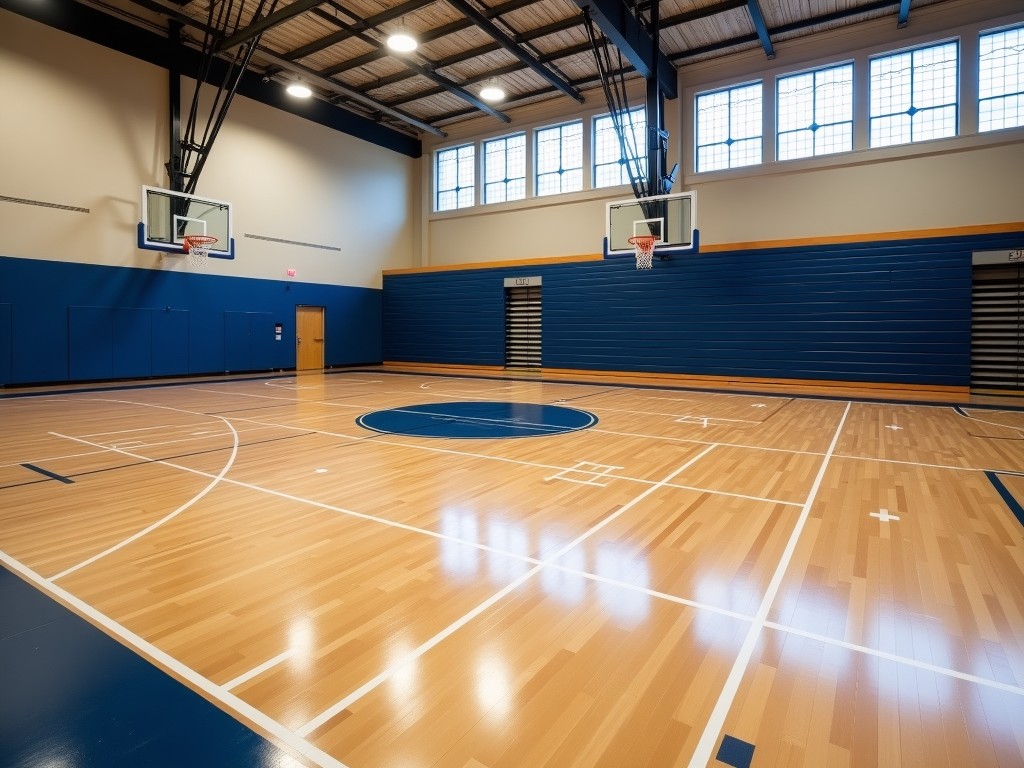
Custom Vinyl Sports Gym Flooring Top Factory
Custom Vinyl Sports Gym Flooring – Top Factory
This product consists of a polyvinyl chloride (PVC) wear layer bonded to a closed‑cell foam backing, providing a resilient surface that combines impact attenuation with dimensional stability.
Material Composition and Structure
The wear layer typically contains a plasticized PVC compound with a thickness ranging from 0.8 mm to 1.5 mm, formulated to resist abrasion from athletic footwear and equipment.
Beneath the wear layer, a foam backing engineered from expanded polyethylene or EVA delivers shock absorption values between 25 % and 40 % when measured according to ASTM F2772.
A stabilizing layer of fiberglass reinforcement is often incorporated to limit dimensional change under temperature fluctuations, maintaining length stability within ±0.2 % over a 24‑hour cycle at 23 °C.
Performance Characteristics
| Property | Typical Range | Test Method |
|---|---|---|
| Wear Layer Thickness | 0.8 mm – 1.5 mm | ISO 24340 |
| Total Thickness | 2.0 mm – 4.5 mm | ISO 24346 |
| Shore A Hardness | 85 – 95 | ASTM D2240 |
| Coefficient of Friction (dry) | 0.5 – 0.7 | ASTM F2913 |
| Shock Absorption | 25 % – 40 % | ASTM F2772 |
| Indentation Resistance (static) | ≤0.15 mm | ISO 24343‑1 |
Customization Options
- Overall thickness selectable from 2.0 mm to 4.5 mm in 0.5 mm increments
- Wear layer thickness adjustable between 0.8 mm and 1.5 mm to match expected traffic intensity
- Color matching to Pantone or RAL standards, with options for speckled or solid finishes
- In‑lay graphics or logo embedding using UV‑cured inks that do not compromise wear layer integrity
- Edge treatments: straight cut, beveled, or interlocking tongue‑and‑groove profiles
- Backing variations: closed‑cell foam for shock absorption or reinforced vinyl for high‑load areas
Installation Considerations
Subfloor flatness should not exceed 3 mm deviation over a 2 m span to prevent telegraphing of imperfections through the thin wear layer.
When using adhesive installation, a pressure‑sensitive acrylic‑based adhesive compatible with PVC is recommended, applied at a coverage rate of 250 g/m².
For loose‑lay systems, a perimeter expansion gap of 10 mm is required to accommodate thermal expansion, with the gap concealed by a flexible vinyl cove.
Seams can be heat‑welded using a compatible PVC welding rod, producing a joint with tensile strength exceeding 80 % of the base material.
Quality Control Process
Incoming PVC resin is screened for melt flow index and particle size distribution to ensure consistent compounding.
During extrusion, online laser thickness monitors track wear layer deviation, triggering automatic adjustments if tolerance exceeds ±0.05 mm.
Finished rolls undergo a 24‑hour conditioned rest at 23 °C/50 % RH before measuring hardness, indentation, and dimensional stability.
A random sample from each batch is subjected to an accelerated aging test (UV‑B 0.68 W/m², 50 °C) for 500 hours, after which color change (ΔE) and tensile retention are evaluated.
Typical Applications
Basketball courts benefit from the uniform coefficient of friction that supports consistent shoe‑slide characteristics, reducing the risk of ankle sprains during lateral movements.
Multi‑purpose gyms that host volleyball, badminton, and fitness classes require a surface that offers adequate shock absorption for jump landings while resisting indentation from heavy equipment.
Weight‑training areas utilize the flooring’s high‑density backing to distribute point loads from dumbbells and racks, protecting the subfloor from concentrated stress.
The low‑maintenance nature of vinyl—requiring only neutral pH cleaning and periodic buffing—makes it suitable for facilities where downtime for upkeep must be minimized.
Frequently Asked Questions
Can dimensions be customized?
Yes, both roll width and length can be tailored to project specifications, with standard roll widths of 1.8 m or 2.0 m and custom lengths available upon request.
What information is required before quotation?
Required details include intended sport or activity, expected traffic load, subfloor condition, desired thickness, wear layer preference, and any graphic or logo requirements.
How is quality inspected?
Inspection includes dimensional checks, hardness testing, accelerated aging, and visual assessment for surface defects, all performed per internal QC protocols aligned with ASTM standards.
What packaging methods are available?
Products are typically wrapped in polyethylene film, placed on sturdy pallets, and secured with corner protectors; custom crating can be arranged for overseas shipments.
What is the typical production lead time?
Lead time varies with complexity but generally ranges from 3 to 5 weeks for standard configurations, with expedited options available for urgent projects.