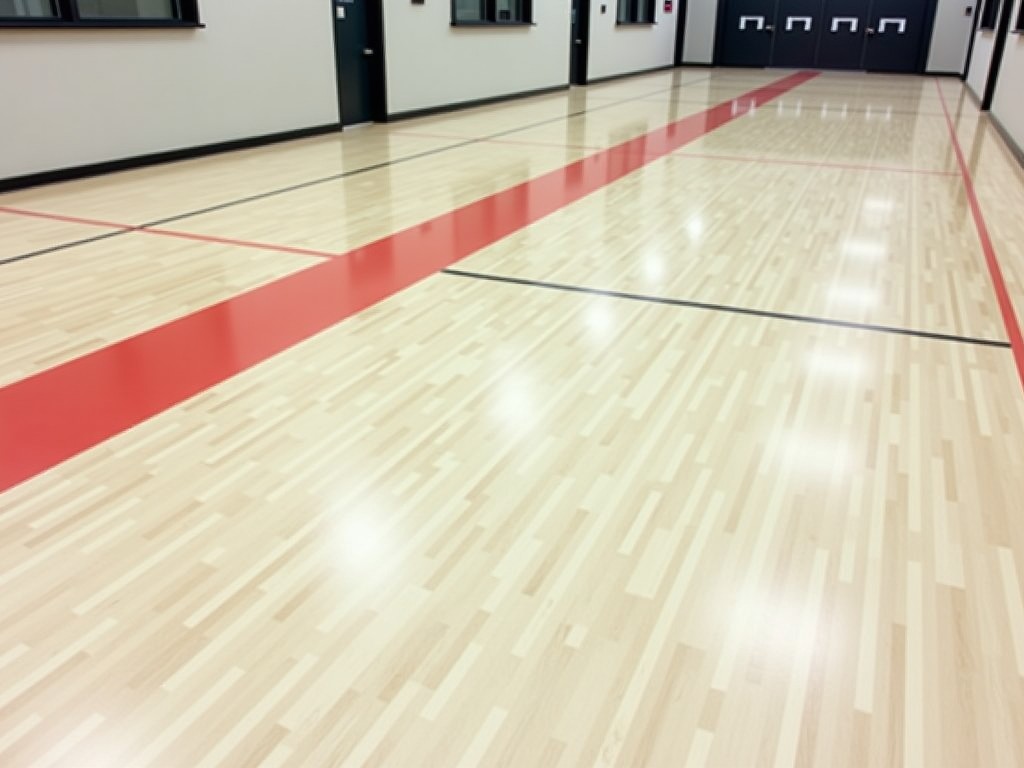
China Commercial Thick Vinyl Plank Flooring Factory
China Commercial Thick Vinyl Plank Flooring Factory
China Commercial Thick Vinyl Plank Flooring – Factory Overview
The product consists of a multi‑layer composite where a wear‑resistant top layer protects a printed design film, which is bonded to a rigid core and a backing layer. This structure provides dimensional stability under varying temperature and humidity conditions typical of commercial interiors. The overall thickness ranges from 5 mm to 8 mm, depending on the intended traffic load.
Product Structure and Materials
From top to bottom, the flooring includes a UV‑cured polyurethane wear layer, a high‑definition printed film, a stone‑plastic composite (SPC) core, and a backing layer of recycled PVC. The wear layer thickness is expressed in mils (1 mil = 0.0254 mm) and directly influences abrasion resistance measured by Taber testing.
The SPC core blends calcium carbonate powder with polyvinyl chloride in a ratio typically around 60:40 by weight, providing a balance between rigidity and impact resistance. This composition reduces vertical deflection under concentrated loads compared with traditional wood‑plastic cores.
- Wear layer: 12 mil, 20 mil, or 28 mil (0.30 mm, 0.51 mm, 0.71 mm)
- Core thickness: 4 mm to 6 mm (adjustable)
- Overall plank width: 150 mm, 180 mm, or 225 mm
- Length: 1200 mm to 1800 mm (standard)
Technical Specifications
| Parameter | Typical Value | Test Standard |
|---|---|---|
| Total thickness | 5.0 mm – 8.0 mm | ISO 24346 |
| Wear layer thickness | 0.30 mm – 0.71 mm | ASTM F410 |
| Dimensional stability (heat) | ≤0.25 % after 6 h at 80 °C | ISO 23999 |
| Residual indentation | ≤0.05 mm | ASTM F1914 |
| Slip resistance (wet) | R10 (DIN 51130) | DIN 51130 |
| Fire rating | Bfl‑s1 (EN 13501‑1) | EN 13501‑1 |
Performance Characteristics
Abrasion resistance is quantified by the number of cycles before wear layer failure in a Taber test; typical values exceed 10,000 cycles for a 20 mil wear layer, indicating suitability for high‑traffic retail corridors.
The SPC core contributes to impact sound reduction; laboratory measurements show a ΔLw of approximately 18 dB when installed over a concrete subfloor with an appropriate underlayment.
Because the core contains no wood fibers, the product exhibits negligible swelling when exposed to intermittent moisture, making it appropriate for areas prone to spills such as cafeterias and healthcare waiting rooms.
Installation Guidelines
The subfloor must be flat within 3 mm over a 2 m radius, clean, dry, and free of contaminants. Any existing coating should be removed to ensure proper adhesion of the floating lock system.
Planks should be stored flat in the installation environment for at least 48 hours prior to laying, allowing the core to equilibrate to ambient temperature and humidity.
- Lay the first row with the tongue facing the wall, maintaining a 5 mm expansion gap.
- Engage the locking system by angling the plank and pressing down until a click is audible.
- Stagger end joints by at least 200 mm between adjacent rows.
- Cut the final row to width using a fine‑tooth saw, preserving the expansion gap.
- Install perimeter trim after the floor is fully laid.
Typical Applications
In retail environments, the flooring resists rolling loads from pallet jacks and constant foot traffic, while its low‑maintenance surface reduces cleaning cycles and associated labor costs.
Hotel lobbies and corridors benefit from the product’s slip‑resistant surface and acoustic damping, which contributes to guest comfort and complies with safety regulations for public spaces.
Healthcare facilities require flooring that does not harbor pathogens; the non‑porous wear layer can be disinfected with standard hospital‑grade agents without degradation, and the dimensional stability prevents gaps where contaminants could accumulate.
Quality Assurance
Each production lot undergoes inline monitoring of wear layer thickness via laser gauging, with statistical process control limits set at ±5 % of the target value. Finished planks are sampled for Taber abrasion, dimensional stability, and chemical resistance according to ISO 10582.
- Wear layer thickness uniformity
- Surface gloss and color consistency
- Locking joint strength (tensile shear)
- Residual indentation after static load
- Formaldehyde emission (EN 717‑1)
Customization Options
The printed film can be supplied with any high‑resolution image, allowing reproduction of wood, stone, or abstract patterns. Color matching is performed using spectrophotometric analysis to achieve ΔE < 2.0 relative to the reference sample.
Plank width and length can be adjusted in increments of 10 mm to suit modular layouts, while the overall thickness can be increased up to 10 mm for extra‑heavy duty zones by adding a reinforced backing layer.
- Wear layer thickness (12‑mil to 30‑mil)
- Surface texture (embossed, hand‑scraped, smooth)
- Edge treatment (square, beveled, micro‑bevel)
- Backing material (standard PVC, cork‑reinforced, acoustic foam)
Packaging and Logistics
Planks are stacked in cartons of 20 kg maximum weight, each carton containing a variable number of planks based on dimensions. Cartons are sealed with polyethylene film and placed on pallets stabilized with corner protectors and stretch wrap.
A standard 20‑foot container holds approximately 14 pallets, allowing efficient shipment to overseas destinations while keeping the product flat to prevent warping.
FAQ
Can dimensions be customized? Yes, plank width, length, and overall thickness can be adjusted according to project requirements; tooling changes are typically completed within two weeks.
What information is needed for a quotation? Please provide the desired wear layer thickness, overall dimensions, order quantity, and any specific design or color requirements.
How is quality inspected? Inline laser gauging checks wear layer thickness, while finished samples undergo Taber abrasion, dimensional stability, and chemical resistance tests per ISO standards.
What packaging options are available? Standard cartons of 20 kg max, palletized with stretch wrap; custom packaging such as corrugated sleeves or moisture barriers can be arranged upon request.
What is the typical production lead time? For standard specifications, lead time is 3‑4 weeks after receipt of confirmed purchase order; customized items may require an additional 1‑2 weeks for tooling.
For detailed technical specifications, sample availability, or to discuss a custom project, please contact our sales engineering team.