Bulk Commercial Cushioned Vinyl Sports Flooring Company
Bulk Commercial Cushioned Vinyl Sports Flooring Company
Bulk Commercial Cushioned Vinyl Sports Flooring
This product consists of a homogeneous vinyl wear layer bonded to a closed‑cell foam cushion and a stabilizing backing, supplied in wide rolls for seamless installation over large floor areas. The construction is engineered to provide consistent shock absorption, slip resistance, and dimensional stability under repeated athletic loads.
Construction and Materials
The wear layer is a calendered PVC compound with a nominal thickness of 1.2 mm and a Shore A hardness of 90±5, providing abrasion resistance suitable for court sports. Beneath it, a cross‑linked polyethylene foam core delivers a compressive modulus of 0.45 MPa and a thickness of 8 mm, contributing to vertical deformation values within the 2.0‑3.5 mm range specified for multi‑use surfaces. A non‑woven polyester backing adds tensile strength of ≥15 kN/m and prevents moisture migration.
All layers are laminated using a solvent‑free adhesive system that achieves a peel strength of ≥4.0 N/mm, ensuring long‑term bond integrity under temperature fluctuations from –10 °C to +50 °C. The overall product density averages 1.25 g/cm³, which facilitates handling while maintaining inertia for impact load distribution.
Performance Characteristics
| Property | Typical Value | Test Standard |
|---|---|---|
| Total Thickness | 10.0 mm ±0.5 mm | ASTM F386 |
| Wear Layer Thickness | 1.2 mm | ASTM F410 |
| Shock Absorption (Vertical Deformation) | 2.8 mm (average) | EN 14904 |
| Coefficient of Friction (Dry) | 0.65‑0.80 | ASTM D2047 |
| Residual Indentation after 500 kg Load | ≤0.15 mm | ASTM F970 |
Typical Applications
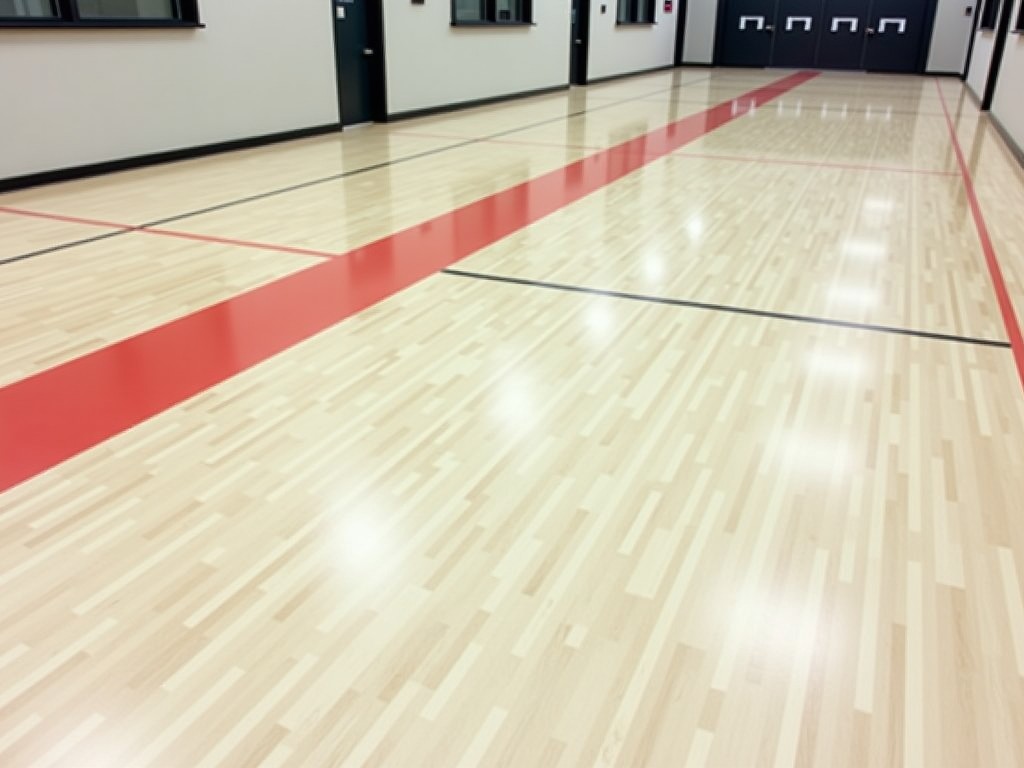
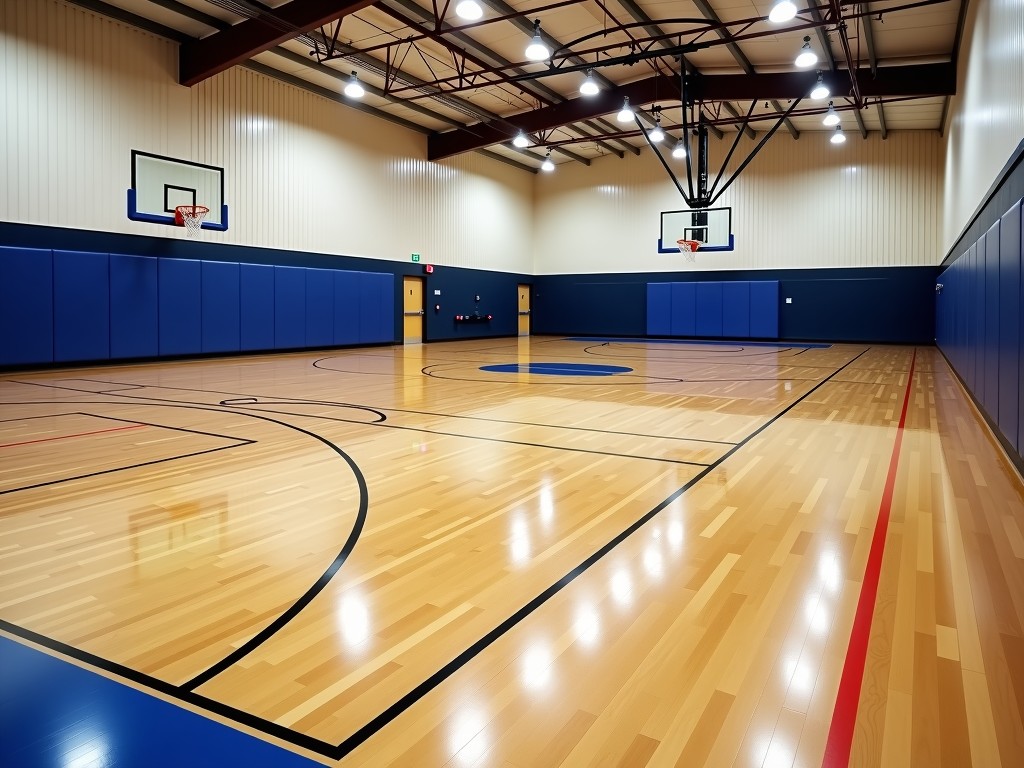
The flooring is installed in facilities where athletes perform multidirectional movements, requiring a surface that mitigates joint stress while delivering reliable traction. Examples include high‑school gymnasiums, community recreation centers, and multipurpose courts used for basketball, volleyball, and badminton.
In fitness environments, the cushioning layer reduces impact forces during plyometric exercises and weight‑lifting platforms, contributing to lower reported lower‑back discomfort among users. The wear layer’s resistance to scuffing from shoe soles and equipment wheels supports long‑term appearance with minimal maintenance.
Because the product is supplied in rolls up to 2 m wide and 30 m long, it accommodates large, uninterrupted spaces, reducing seam frequency and associated tripping hazards in open‑plan layouts.
Customization Options
- Color pigments: customizable to match corporate or facility branding (standard palette includes 12 solid shades).
- Overall thickness: adjustable from 8 mm to 12 mm by varying foam core depth while maintaining wear layer constant.
- Roll width: available in 1.5 m, 1.8 m, and 2.0 m formats to suit site logistics.
- Surface embossing: optional fine‑texture patterns to enhance slip resistance under wet conditions.
- Backing additives: antimicrobial or UV‑stabilized formulations upon request.
Quality Control and Testing
Each production lot undergoes inline thickness monitoring using laser gauges with a tolerance of ±0.1 mm. After lamination, samples are cut for abrasion resistance testing per ASTM D4060, targeting a weight loss of ≤0.02 g after 1000 cycles.
Shock absorption is verified on a calibrated impact rig that measures vertical deformation under a 20 kg falling mass; results must fall within the 2.0‑3.5 mm band for acceptance. Chemical resistance is assessed by immersing specimens in common gym cleaning agents for 24 h, checking for delamination or discoloration.
Documentation includes a material safety data sheet (MSDS), ISO 9001‑based traceability records, and a test report summary supplied with each shipment.
Frequently Asked Questions
Can the thickness be adjusted for specific sport requirements?
Yes. The foam core thickness can be increased or decreased in 1 mm increments to achieve target shock absorption values, while the wear layer remains at 1.2 mm to preserve wear performance.
What information is needed to receive a quotation?
Project planners should provide the total area to be covered, desired overall thickness, preferred roll width, color selection, and any special backing treatments. Site conditions such as subfloor type and expected load levels help us recommend the appropriate specification.
How is product quality verified before shipping?
Every roll is sampled for thickness, hardness, and peel strength. A final visual inspection checks for surface defects, and a random selection undergoes the full performance test suite outlined in the quality control section.
Contact for Technical Inquiry
For detailed specifications, sample requests, or project‑specific consultation, please reach out to our technical team via the contact form. Providing the information outlined in the FAQ will enable us to generate an accurate quotation and lead‑time estimate.